Dr Kirsty Chidgey’s plan for a stronger New Zealand pork industry
Imported pork supplies more than 60% of what New Zealanders eat and the domestic sector is smaller than it was in the 1990s. Dr Kirsty Chidgey says a high health status, strong welfare standards and a focused research programme are the foundations for a stronger industry.
IMPORTED PORK NOW SUPPLIES more than 60% of what New Zealanders eat and it arrives from more than 20 countries.
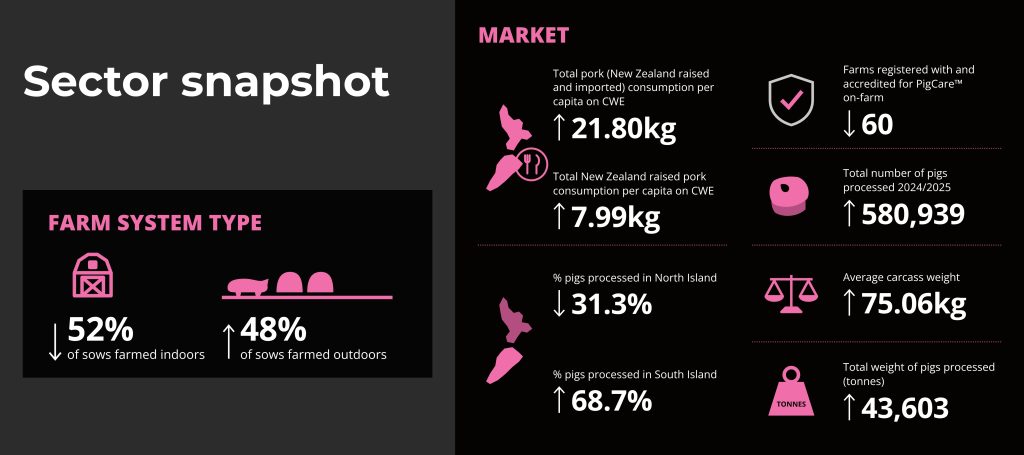
“Over 60% of the pork consumed in New Zealand is imported from over 20 different countries,” says Dr Kirsty Chidgey, a Massey University senior research officer and New Zealand Pork animal welfare science advisor. Kirsty says imports overtook domestic supply by volume in about 2014, largely because they are much cheaper, in part due to subsidies and lower production standards in other countries. A relaxed import health standard for pork in 2014 also made it easier to bring product in. By July 2026, imports made up just over 60% of total supply.
Meanwhile, the domestic pig kill has fallen from 773,270 pigs in 1996–97 to 580,939 in 2024–25, about a quarter fewer. Heavier pigs have cushioned the drop, with the average carcass weight rising from 64kg in 1999–2000 to 75kg in 2024–25, but total carcass weight produced still slipped from 47,953 tonnes to 43,603 tonnes.
Labels that confuse
The Consumers’ Right to Know (Country of Origin of Food) Act 2018 requires origin labelling on fresh and cured pork such as bacon, ham and prosciutto. Sausages, salami, luncheon, marinated pork, pizza toppings and ready-made meals fall outside the rules.
Kirsty says the regulations are not fit for purpose in practice, with imagery and phrases such as ‘product of NZ’, ‘NZ’s favourite’ and ‘Marlborough salami’ confusing shoppers by suggesting they are made using New Zealand pork, when they use imports. NZ Pork complained and Parliament’s Regulations Review Committee agreed the rules should be revisited. However, Minister of Commerce and Consumer Affairs Cameron Brewer’s recent response to that finding was that he is “not aware of evidence that this is occurring on a scale that would justify further regulatory change”.
Feed and funding
Feed accounts for 60% to 70% of the cost of production, Kirsty says, and energy and fertiliser costs are rising. Farmgate returns are low and the sector has little control over feed prices. Research money is tight too. A small, levy-funded sector with a shrinking levy base struggles to meet the co-funding thresholds for large bids and funding is often tied to exports, which the sector barely has. NZ Pork has responded with its own research programme built around four priorities: better biosecurity, positive pig welfare, environmental stewardship, and consumers, products and markets. Kirsty sees ways to cut costs by recycling resources, with biogas and solar among the options.
Biosecurity is an industry-critical issue. Foot and mouth disease operational agreement supports co-funded projects with the Ministry for Primary Industries (MPI) through to 2028. Environmental rules are often written for pastoral farming and do not suit pig systems, so the sector needs its own research on effluent and odour. A new partnership with Lincoln University’s Agribusiness and Economics Research Unit will examine domestic market dynamics and food service demand for New Zealand born and raised pork and look for more value in the “fifth quarter” of the carcass.
Welfare brings investment
Revised animal welfare regulations mean many farmers must make significant investments over the next 10 years. Kirsty says that has already changed one thing above all.
“Their confidence to invest, which is already happening, is the biggest change for having those regulations in place,” she says. Research is helping them choose. In a trial co-funded by MPI, the SunPork Maternity Ring was tested under New Zealand conditions against farrowing crates. Piglets born alive, pigs weaned per litter and total piglet losses per sow did not differ, although more piglets were crushed in the rings.
Health a competitive advantage
Kirsty says pig health is a competitive advantage because New Zealand is free from many diseases found overseas, and protecting that status is a key part of the research programme. Pork also has a low environmental footprint, responsible for 0.1% of New Zealand’s total agricultural greenhouse gas emissions.
Kirsty says a cohesive, long-term and strategic approach is needed to meet the challenges head on. The pathway to profitability will always be challenging for a small, domestically focused sector, she says, but the foundations are already there: a globally recognised high health status, efficient production systems and high animal welfare and environmental standards.
First published in CountryWide, Summer 2026-27, pages 39 to 40.