Cows return to hill country
Beef cows are making a slow but steady comeback to the hill country of Limestone Downs. Massey University modelling shows that decreasing sheep and increasing cattle numbers is more profitable, and is likely a win-win for both stock classes. Words & Photos Tony Leggett.

Economic Service data suggests the number of beef cows nudged past one million head in the November 2025 livestock survey, with growth across every region except Waikato. It’s still a long way from the 2.1 million beef cows that grazed NZ farms in the early 1990s, but the trend is positive again.
Improving farmgate prices, continuing farm labour challenges, and the ability of beef cows to help control resistant parasites in sheep flocks and lift lamb performance by grooming pasture, are likely reasons behind the lift in numbers.
But recent modelling by a team at Massey University has produced some thought-provoking results when it considered the profitability of a range of beef cow systems for typical hill country farms in the late 2020s.
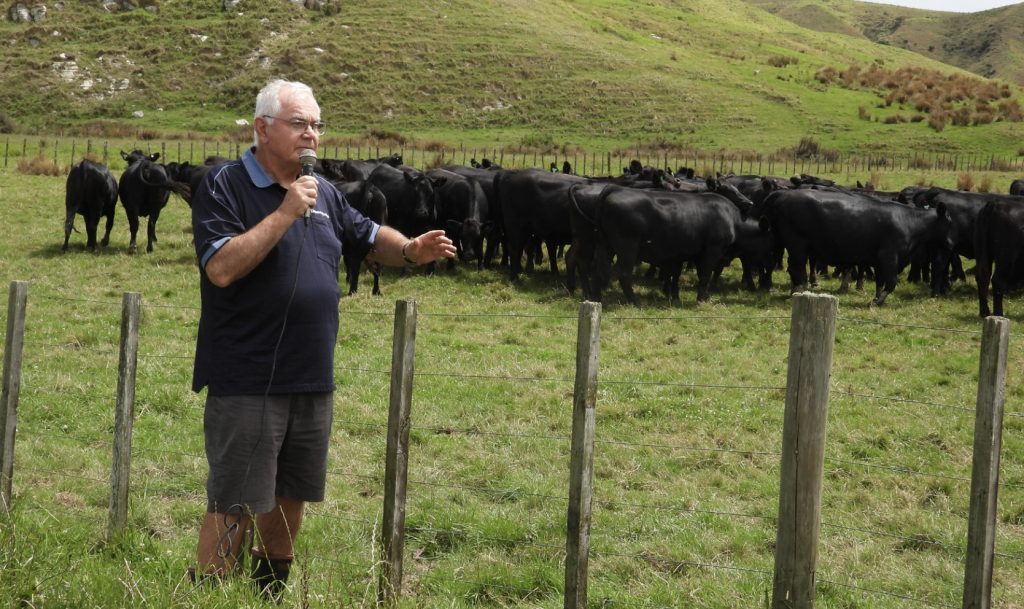
Massey University Professor, Steve Morris, presented the modelling results at a field day at Limestone Downs, near Port Waikato, in mid-February. Limestone Downs is rebuilding its breeding cow herd to help cope with an influx of kikuyu which is now dominating its coastal country and impacting livestock performance.
The modelling exercise tapped into Economic Service data from hill country farms, allowing for all the feed costs and income associated with a range of different beef cow systems.
Breed changes, breeding replacements versus buying in, use of maternal and terminal sires, and selling progeny in store condition or prime direct to slaughter, were all evaluated.
The sheep operation was standardised at the national lambing percentage average of 135% across all the different cow system scenarios considered.
The results were presented as the percentage gain or loss in cash operating surplus (COS) compared with a base system, to show the relative performance for each option and avoid the impact of variations in beef schedule prices throughout the year.
Steve says the modelling reinforced the gain in profitability when calf weaning weight increases.
Lower mature weight cows are also more profitable because they consume less feed to maintain themselves through the year and their calves are a greater percentage of their own liveweight at weaning.
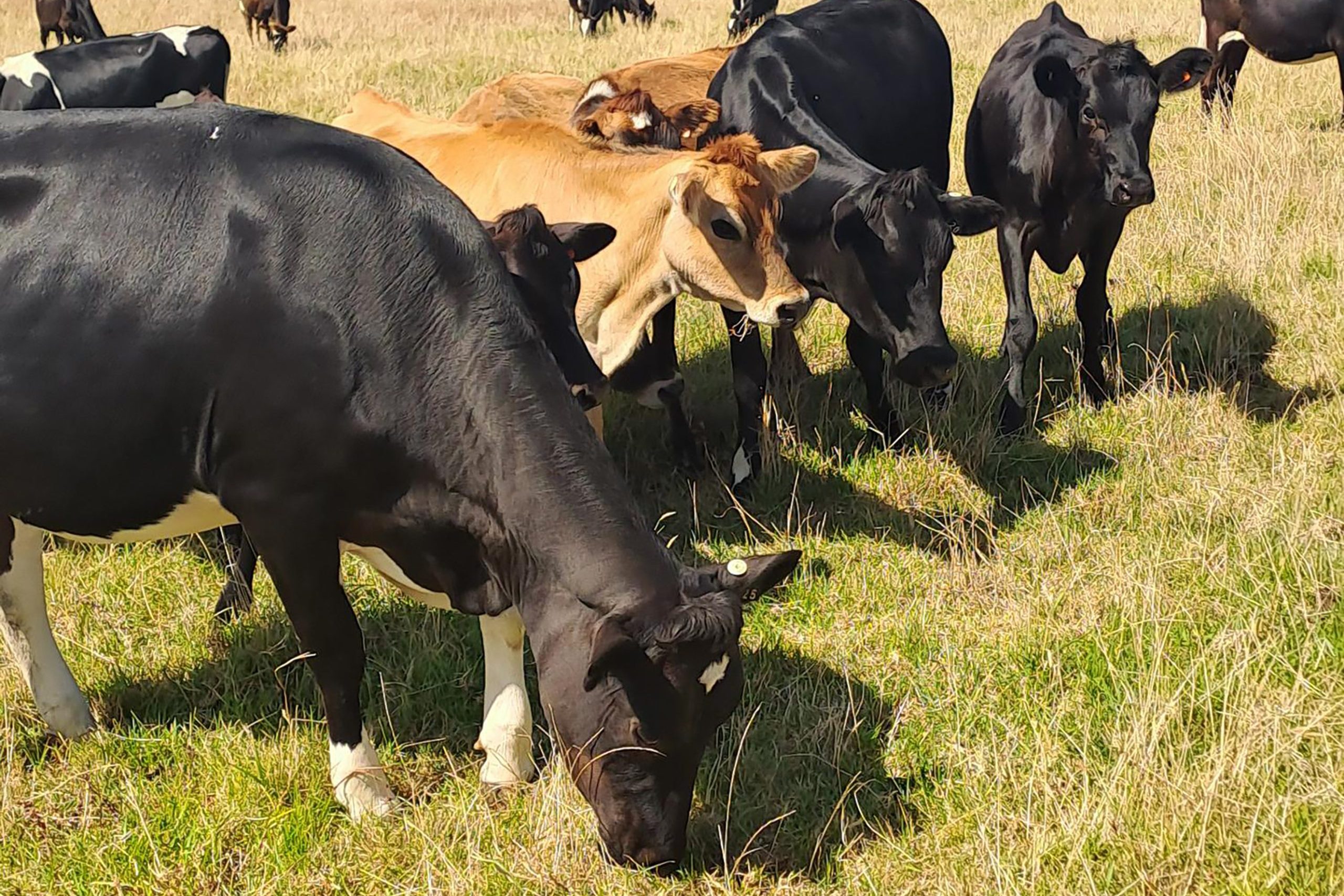
The modelling also showed that cows bred from crossing Angus sires over Friesian cows consistently produce more COS when compared to straight Angus cow systems.
“Lower mature weight cows are more profitable because they consume less feed to maintain themselves through the year and their calves are a greater percentage of their own liveweight at weaning.” – Professor Steve Morris, Massey University
Selling prime has a clear advantage over store systems when it comes to COS, but Steve accepts getting cattle through two winters on typical hill country farms is difficult for many properties. Decreasing sheep and increasing cattle numbers earns more COS and will likely benefit both lamb performance through pasture grooming and parasite exposure in young sheep.
Steve took aim at the trend towards heavier mature weight cattle, driven by excessive emphasis on growth rate selection by many cattle stud breeders.
He is pleased to see more stud breeders including cow mature weight in their selection indexes, but says “more work is needed there” to create more efficient, moderate weight cows for hill country farms.
The Massey University study investigated the impact on COS in a range of beef cow systems on a typical Class 4 North Island hill country property.
Researchers set up a base option at a 60:40 sheep to cattle ratio and compared selling prime and store condition progeny from Angus and Angus-cross cow systems, naturally mated and mated through artificial insemination (AI).
They also compared the impact of different cow weights, for a self-replacing Angus herd with and without an increase in calf weaning weight. Also compared was the impact of increasing the weaning rate from 84% to 90%. The study then considered changing the breed to an Angus-Friesian cross cow with replacement heifers bred from the dairy sector, using sexed semen, and selling the progeny store or prime, with and without premiums for Angus, using a natural mating option not artificial breeding.
When you put a registered Angus bull over an Angus-Friesian cow, progeny can qualify for the Angus Pure branded beef programme and receive significant premiums. Researchers also looked at the impact of changing the sheep to cattle ratio, right down to 20% sheep and 80% cattle.
What happens to cash operating surplus (COS) under different scenarios
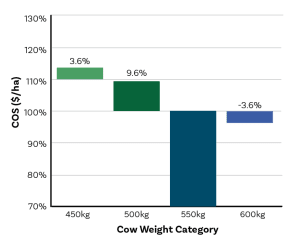 Scenario 1 – Change cow liveweight without increasing calf weaning weight
The base cow is 550 kg liveweight, all calves 220 kg at weaning, 84% weaning and mating heifers to calve first at two years of age. Reducing cow liveweight to 500 kg/cow produced 9.6% more COS than the base system. Reducing cow liveweight to 450 kg created a further 3.5% improvement in COS. However, increasing cow liveweight to 600 kg reduced the COS by 3.6% from the base system.
The gain in COS from running lighter cows comes from them eating less per head, so more can be farmed.
Conversely, in this comparison, the heavier cows consume extra feed for no gain in weaning weight, so they are less efficient. The heavier, larger cows might be better at eating excess low-quality feed in summer, but Steve said there needs to be less of them over the full year because they are heavier and have a higher maintenance requirement.
“In monetary terms, this highlights that unless heavier cows wean more calf liveweight, they are losing money compared to the base system and more so for the 500 kg cows and 450 kg cow option.”
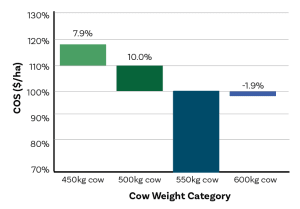 Scenario 2 – Change cow liveweight and increasing calf weaning weight
Researchers found that even when calf weaning weights were lifted 10% for the heavier 600 kg cows, they still produced 2% less COS than the 550 kg base option, 10% less than the 500 kg cow option and nearly 18% less than the 450 kg cow option.
“So, the heavier calves do not compensate for the impact of running fewer bigger cows and all the costs associated with that.”
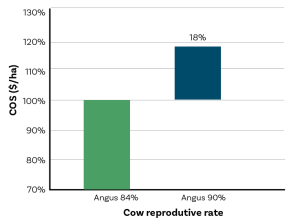 Scenario 3 – Increase cow reproductive rate (weaning %) by 6% from 84 to 90%
Researchers found the 550 kg base option cows doing 84% weaning percentage produced 18% less COS than cows with the same liveweight weaning at 90%.
A big driver of the extra cash from the higher weaning percentage was being able to sell more surplus heifer calves and run a lower replacement rate in the herd because fewer replacement heifers are kept.
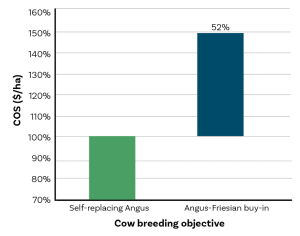 Scenario 4 – Change breeding policy to buy in Angus-Friesian cross heifers and mate using AI
Compared with a base option of a self-replacing Angus herd doing 84% weaning and cows at 550 kg, moving to bought-in Angus-Friesian heifers, there is a 52% improvement to the COS when they are mated to terminal sires. The big improvement in COS reflects heavier calves at weaning, selling 100% of them and being able to use sexed semen from high genetic merit bulls in the AI programme.
“But we’re in hill country, and how do you manage the potential disease risk when you’re buying in replacement calves at say 100 kg liveweight, and how do you manage AI in a large beef cow system when a lot of stuff is going on on-farm in December?
“Will those Angus-Friesian cows cope with the managing pasture role? Some say they will do as well as straight Angus cows, others say they won’t,” Steve says.
Scenario 5 – Staying with Angus-Friesian cross cows, naturally mated to terminal or Angus sires and sold store
Base option is Angus cow 550 kg, rearing a 220 kg calf at 84% weaning rate.
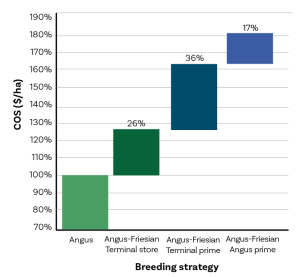
When researchers compared buying-in Angus-Friesian cows and mating them to terminal sires, for instance Charolais, there was a 26% gain in COS over the base option, from being able to buy in replacement Angus-Friesian heifer calves for less than Angus heifer calves, and from selling terminal sire progeny from Angus-Friesian cows at heavier weights. Steve says replacement Angus-Friesian heifer calves typically cost $600-$700 at 100 kg liveweight, considerably less than an Angus heifer calf at weaning which could be more than $1000/head.
 Scenario 6 – Staying with Angus-Friesian cross herd, mating to either terminal sires or Angus sires, and sold prime
Researchers found that Angus-Friesian cows mated to terminal sires in either a store system or prime system delivered more COS (26% and 62% respectively) than a straight Angus system based on 550 kg cows rearing 220 kg calves and weaning 84%.
The greatest COS, 79% more than the base Angus option, was generated from using registered Angus bulls over Angus-Friesian cows and selling the three-quarter Angus progeny into the Angus Prime branded beef programme which has advertised premiums of $0.40-$0.50/kg or more.
 Scenario 7 – Changing the ratio of sheep to cattle stock units
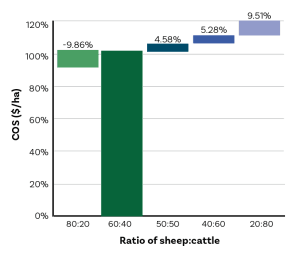
Researchers found that lifting the cattle stock units generated more COS compared with the base of 60:40 sheep to cattle.
When the number of sheep was increased to 80:20, COS dropped by almost 10% compared with the 60:40 option.
“Don’t forget, only maybe 10 years ago, 80:20 sheep to cattle was a typical stock ratio on many North Island sheep and cattle properties.”
At 50:50, the improvement was 4.6%, at 40:60 it increased to almost 10% and at 20:80, the improvement was nearly 20% over the base 60:40 option. Steve noted that increasing cattle numbers also had other benefits – less labour, less need to maintain woolsheds and yards, greater control of the pasture and likely better control of sheep parasites. Neither the effect of improved pasture control nor improved sheep parasite control were included in the modelling. The sheep flock was fixed at the national average of 135% weaning across all the scenarios, a point that drew some debate among the audience at the Limestone Downs field day.
Some local farmers suggested a lambing performance nearer 150% weaning is achievable and wondered what impact it would have on the relative COS for the beef systems.
Massey University Professor, Paul Kenyon, who was also involved in the modelling project, agreed that improving the sheep performance would have an effect. However, if the lambing percentage rose above 150%, the improvement in profit would diminish because lamb and ewe losses increase with more triplets and quads appearing.
Getting the basics right is critical to profitability
The Massey University beef cow modelling project reinforces the need to get the basics right, regardless of seasonal conditions or the system.
“If we are going to have a beef cow herd and you want it to be profitable, they should be weaning more than 90 calves per 100 cows mated,” says Steve.
He admits it is difficult to achieve that performance in a three-cycle mating period.
“You put the bulls out for three cycles, 95% get in calf, so there’s 5% dry. Of that 95% in calf at pregnancy testing time, only 95% rear a calf, and that makes 90%.
“To get up past 90%, you really need more than 95% pregnant and less than 5% losses through pregnancy.”
Steve says weaning weight is also critical to herd profitability and calves should be 200 kg or more by weaning.
“I know that doesn’t happen because I see plenty of calves at the weaner fairs that come through at way below 200 kg.
“You also need to maintain a low death rate in the herd, at less than 4%,” he says.
At the same time, farmers also expect their breeding cows to maintain pasture quality for the sheep flock too, a cost in the cow operation that he says is very difficult to put a value on.
Data from the Beef + Lamb Economic Service shows the top 20% of herds are weaning 92 calves per 100 cows mated and they are growing those calves at 1 kg/day to reach 230-250 kg by weaning – assuming a 30-35 kg calf birth weight.
If those cows were 500 kg at weaning and their calves are 240 kg, that performance equates to 0.48 kg of calf weaned per kg of cow.
“But the reality is there’s not many of those 500 kg cows out there anymore. Everyone is chasing bigger cows, so they are 600 or even 650 kg,” he says.
“Bigger is better is the expectation, but they eat more so you can run fewer of them and they cost more to maintain.”
In terms of herd performance, the Economic Service data reveals serious concerns about the performance of hill country beef herds.
The average calving percentage is 82-83% and there are some classes of hill country where herds are struggling to get to 80% calves weaned to cows mated. Calves are struggling to get to 200 kg by weaning because they don’t put on 1 kg liveweight gain per day. Steve says any calf on its mother should be doing 1 kg/day weight gain, but the average calf weighs 180 kg and cow mature weight is nudging 600 kg.
“There will be farms out there doing better, but are they leaving their calves on those cows for seven or eight months, or leaving bulls out for four or five cycles to get a higher conception rate?”
Steve says the top performing 20% of herds shows average herd performance can be improved.
“The beef cow is back in vogue again, but you have to make sure they produce a calf every year, and make sure their calves are as big as possible at weaning.
“You should mate first calving heifers for two cycles, and accept that you will likely get 85% in calf. That doesn’t really matter because those surplus dry heifers are all right for local trade.
“In an adult cow herd, you want 65% to calve within the first 21 days, 25% in the second 21 days and 10% in the final 21 days for optimal performance,” he says.
He advocates using condition scoring to monitor feeding through the year to ensure cows are in optimal condition at critical times such as mating.