Why genotype your commercial flock?
Anna Vaughan’s Kellogg report shows there is genuine appetite among commercial sheep farmers for genotyping, but concludes no single benefit yet justifies the cost. Words Sarah Perriam-Lampp.
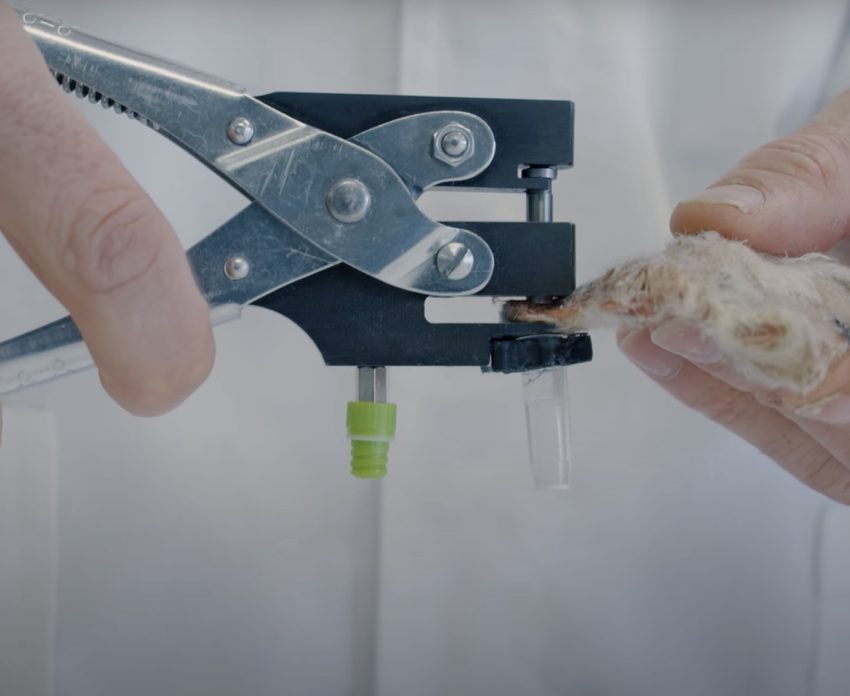
Genomic selection has been available to the New Zealand sheep industry for more than a decade, yet its use remains largely confined to stud breeders. Anna Vaughan set out with her Kellogg’s report to find out whether there is a strategic case and farmer appetite for extending genotyping into the commercial ewe flock.
“There is appetite and early signs of justifying the cost. But cost and infrastructure continue to constrain uptake,” says Anna.
She outlines the benefits that would flow from wider adoption, yet notes survey comments showed the value wouldn’t be captured by the individual farmers who pay for it.
“Genotyping is more than a technical upgrade. It is a strategic lever for industry transformation.”
Anna used a mixed-methods approach: a literature review, a national survey that drew 65 responses from 11 regions, and nine semi-structured interviews with genetics specialists, industry leaders, a processor, a genomics service provider and a rural banking specialist.
Why it matters now
The commercial ewe flock and its progeny sit at the base of the national breeding pyramid but have never been systematically genotyped. That matters because genetic improvement is both permanent and cumulative.
Anna’s report estimates a genetic lag of five to eight years between the stud and commercial tiers (Blair and Garrick, 2007), with modelling showing that performance recording and genotyping in the multiplier tier could cut that lag by two to three years (Santos et al., 2017).
International evidence is striking. In United States dairy cattle, genomic selection lifted annual genetic gain by 50-100 percent for high-heritability traits such as milk yield, and by 300-400 percent for low-heritability traits such as somatic cell count and fertility (García-Ruiz et al., 2016).
The context is a shrinking national flock – down from 57.9 million sheep in 1990 to 23.6 million in 2024 (StatsNZ, 2025) – which Anna argues sharpens rather than weakens the case, because further decline may compromise the sector’s ability to fund industry-level innovation at all.
What farmers want
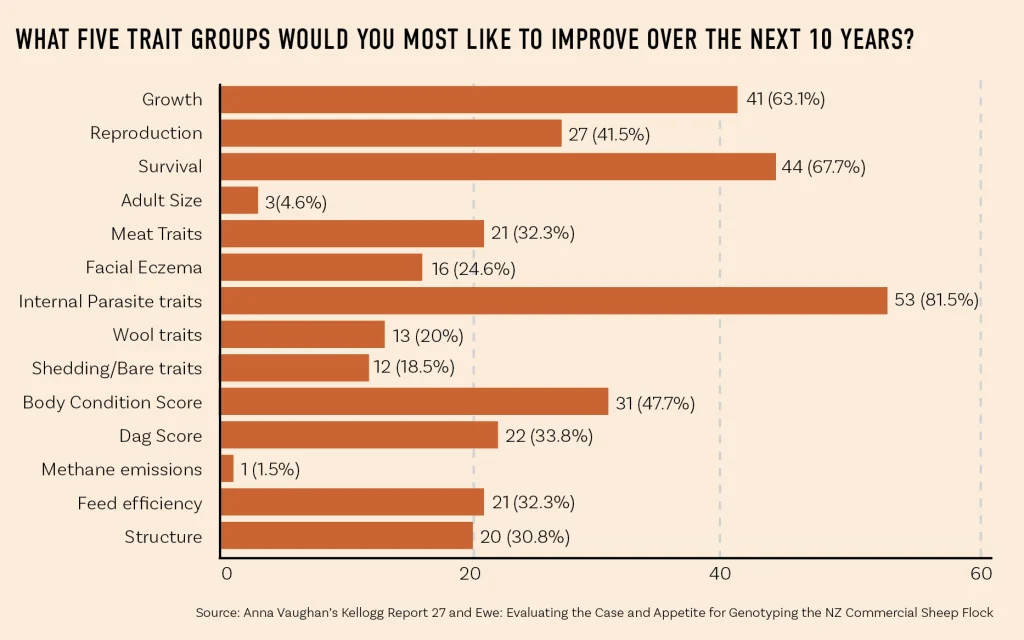
Survey respondents were clear about their priorities. Internal parasite traits topped the list of traits farmers most wanted to improve over the next 10 years at 81.5 percent, followed by survival (67.7 percent), growth (63.1 percent), body condition score (47.7 percent) and reproduction (41.5 percent).
Parasite resistance illustrates where genomics could earn its keep. Triple drench resistance is now present on many New Zealand farms (Techion, 2024), with modelling putting potential losses at up to $96,390 a year for a hill-country sheep and beef operation if resistance is left unaddressed (Beef + Lamb New Zealand, 2024). Romney breeders using RamGuard testing nearly doubled their rate of genetic gain in facial eczema tolerance after adopting genomic selection from 2012 (Amyes et al., 2018).
The cost problem
Cost was the most-selected barrier at 83.1 percent, ahead of uncertainty about return on investment (47.7 percent) and doubts about market premiums (40 percent).
Modelling at 2017 pricing found breakeven took 18-29 years unless genotyping costs fell to NZ$10-25/head, at which point it came back to nine to 11 years (Santos et al., 2017). Current parentage-only genotyping sits at about $10-20/lamb, with low-to-medium density genomic tests starting near $34/head (Totogen, 2025; Zoetis, 2025).
Encouragingly, the benefits are non-linear. Genotyping the top 25 percent of male lambs in a Merino breeding programme lifted genetic gain by 13 percent, 50 percent lifted it by 18 percent, and genotyping all males by 26 percent (Berry & Spangler, 2024) – suggesting optimal sampling thresholds well short of whole-flock coverage.
Trust, autonomy and market failure
Confidence in the technology is qualified rather than absent. While 90.9 percent of respondents felt somewhat or very confident about investing in long-term genetic gain, 65.1 percent said they would use genomic breeding values to select replacements but still rely on visual checks. Half considered a ram hogget with a faecal egg count phenotype under parasite challenge worth NZD$200 more than one with a genomic breeding value alone.
On governance, 76.9 percent said genotyping should be an individual farm decision rather than part of a wider industry strategy, citing farmer autonomy and resistance to top-down mandates.
Yet Anna’s central argument is economic. When a farmer genotypes, the data improves national breeding evaluations and benefits the wider industry. But those collective gains are not captured by the individual, producing underinvestment relative to the industry optimum. She says that is a textbook market failure.
Where to next
Anna’s recommendations for lifting commercial uptake include case studies on lower-cost entry points such as flock sample profiling and parentage-only genotyping, paired with a farmer-friendly return-on-investment calculator; prioritising pain-point health traits – parasite tolerance and facial eczema first – for reference population expansion; co-designing validation scorecards with processors, banks and farmers; bundled, farmer-ready packages from genomics providers; and exploring government-industry co-investment models.
She also flags an equity risk. If commercial farmers can genotype their own ram lambs to use as sires, traditional stud breeding models face disruption and those who have paid to generate phenotypes need a fair return.