Stronger wool, stronger returns
New Zealand grows some of the best strong wool in the world, but why does the value not reach the farm gate? In 2025, Lisa Portas travelled the globe to find out as part of her Nuffield scholarship. Words Sarah Perriam-Lampp.
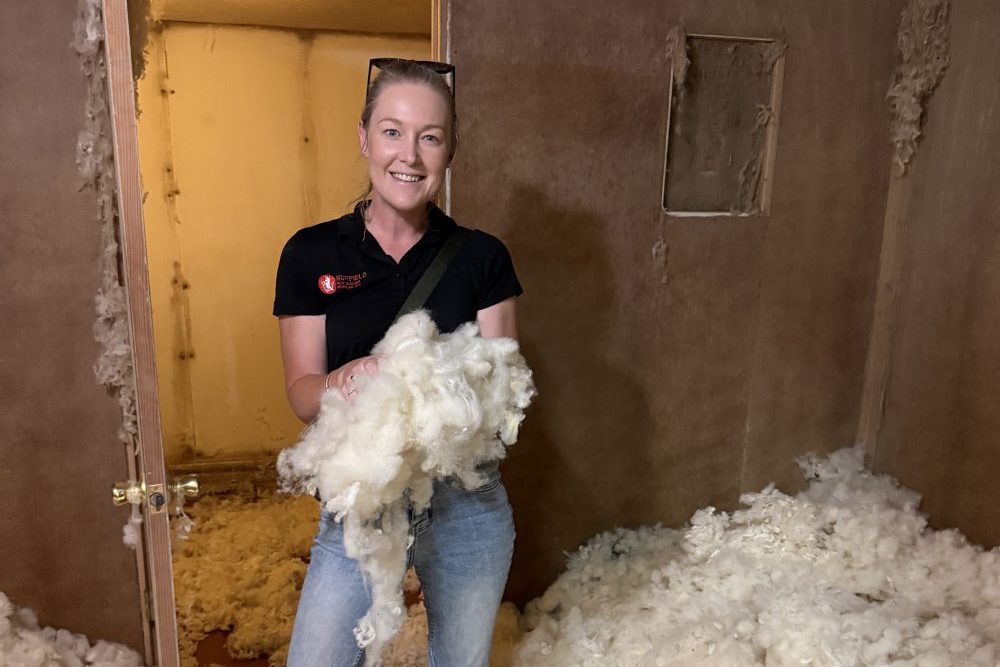
Lisa Portas has spent more than a decade adding value to wool. Lisa, alongside her husband Kurt, were part of the Palliser Ridge executive team for 12 years, running operations spanning honey and agritourism and moving fibre directly to overseas buyers.
“When I started, I saw wool as a commodity off to the auctions and then as these small niche solutions,” Lisa says. “There are so many things in between.
“There’s a place in the middle where we can be a really credible, desirable ingredient or halfway product, where we can fit into other brand’s supply chain,” she says.
Her research took her through the United States, the United Kingdom and Europe, interviewing growers, processors, certification bodies and global brands. Three themes surfaced in every market – certification, credible data and supply chains that are built on purpose rather than left to default.
Certification came first. What New Zealand treats as compliance cost, European buyers treat as credibility they will pay for. In many value-driven markets, recognised third-party accreditation has moved from an optional premium to a condition of participation, with independently governed international schemes preferred over domestic or producer-led ones.
The limitation is recognition. Schemes proliferate and growers move between them because the paperwork does not always convert.
“That’s not translating to something someone will pay for, whether it’s the end brand or whether it’s the end customer,” Portas says.
Data was the second pillar, and her strongest message to growers is that much of it already belongs to them.
“Buyers want really pointy data that can’t be challenged, but then they want these things that will translate to a great story.” – Lisa Portas, 2025 Nuffield Scholar
“Your wool’s tested every time it leaves,” she says. “All of that data is theirs and sitting there. I’d really love farmers to understand the data that’s moving with their products.”
Who holds that data and who uses it, became a question she carried throughout the trip. It also now shapes work she does at AUT, teaching students who source wool for design projects to read a wool spec sheet.
“There’s a piece there for the people who will be the future specifiers. They need to know, the farmers need to know. Everyone in the middle does a fantastic job of already knowing, it’s just how much of that’s shared?
“Buyers want really pointy data that can’t be challenged, but then they want these things that will translate to a great story.”
Shaniko Wool Company in the US showed the commercial version. Certification sits alongside six years of verified soil carbon data across more than 1 million hectares and the brands buying the fibre are contracting on the environmental outcome too.
“For me, that’s such a logical partnership,” she says. “It gives them a really great brand story of, we’re procuring fibre from farms that are improving the environment. Soil carbon in New Zealand is a huge opportunity in itself. I’d love to see us move a bit faster here.”
Some of the overseas soil carbon work she saw was less rigorous than New Zealand would accept. It was still moving money onto farms.
“That doesn’t feel incredibly scientific sometimes. But I tell you what, was it stopping trading and was it stopping income coming to farms?” she says. “We do a really good job of asking everyone what they think about things. The counter side of that is it takes us longer sometimes.”
The third theme was design. The most transparent chain she saw was not fibre at all but Netherlands pork, where every party annually opened its books, right through to the supermarket, so the margin worked for everyone.
“I had never really seen anything that transparent,” she says. “The essence of that is having someone at the other end who cares whether the farmer’s making money. If it’s just ‘I’m trying to get something for a good price,’ it’s not a partnership. It’s buying, and eventually we can be replaced.”
Certainty is the grower’s half of that bargain, even when the market is climbing.
“Soil carbon in New Zealand is a huge opportunity in itself. I’d love to see us move a bit faster here.” – Lisa Portas, 2025 Nuffield Scholar
“To be able to sit down with the banks, with advisors, and go, hey, we’ve actually just locked in for three years or four years – how good is that?”
She sees tightening supply as the thing most likely to force change.
“That wool that we think might be sitting at auction may not be sitting there, so we need to get savvy on procuring it,” she says. “That’s only going to be good for our producers, and about time.”
The domestic signals exist. Keraplast has contracted regeneratively certified growers through Wools of New Zealand at about 25% above market in 2026 – $6.88/kg clean – rising to $2.50/kg above market by year five of the five-year agreement.
“When they do that, it naturally leads farmers to go, ‘Well, would I be in that? Can I actually be part of that?’”
She expects the next generation to arrive with the question already framed as a choice.
“We’ve got so much succession and new energy in the young people, with amazing skills coming into our industry. I think they’ll go looking for partners that align with their values,” she says. “So much of what I saw offshore was, when those values are really strong, quite often there was no concern about paying a little bit more.”
Her closing point is the least dramatic and the most useful.
“We are doing 80% of what most of our markets want anyway,” she says. “I never advise anyone to go out there and do a full 180.”
What it needs is growers who can answer when a buyer comes looking. “I’d love to see farmer education improve to a point where if a brand crosses their path and says this is what we’re looking for, they can straight away go, ‘Yeah, that’s me.’”
The alternative, she writes in her report, is not simply a lower price. “The greater risk may not be declining price but declining eligibility.”