Treat Wearables as a tool, not a system
As virtual fencing and cattle wearables move from buzzwords to real tools being used across sheep and beef breeding and finishing operations on New Zealand farms, one message comes through clearly from Tom Chisholm of AgDesign: the technology is not a silver bullet. Words Sarah Perriam-Lampp.
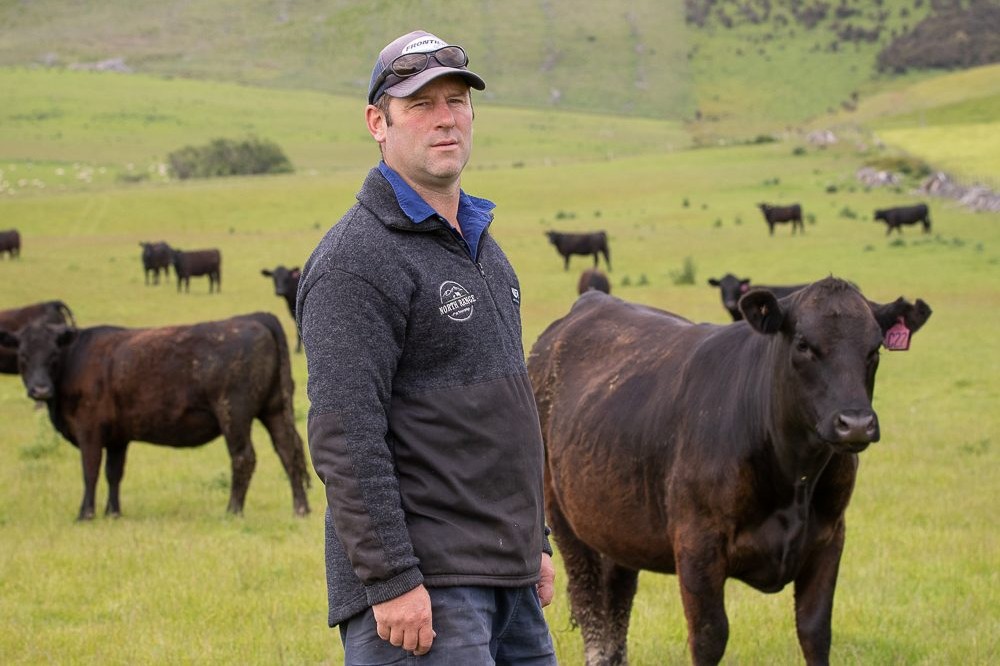
With the rise of cattle wearables, virtual fencing technology on intensive beef finishing operations, Tom Chisholm, from AgDesign, warns many farmers are seeing wearables as a system itself. He’s already seeing a pattern where farmers buy the collars first, then come home and ask, “Now how are we going to use it?” That, he says, is backwards.
After his experience managing Harry Wiers’ Technograzing property, a farming system that was trademarked at Burleigh Farm, near Bulls in the Rangitikei, Tom founded AgDesign as a consulting company to support the design and implementation of grazing systems.
The systems they design were inspired by trials at Aorangi research station during the late 60s and early 70s by Dr Ray Brougham. Ray achieved production of 1100 kg net carcase weight per hectare.
“It’s a tool, just like an electric fence or a tractor, and it only delivers value when it fits into a well-thought-out farm system.” – Tom Chisholm, AgDesign
“It’s a tool just like an electric fence or a tractor and it only delivers value when it fits into a well-thought-out farm system,” explains Tom.
He suggests farmers start with their farm system design and goals, then decide whether wearables are the right tool to support that, not the other way around. The real limiting factor, especially in hill country environments, is water infrastructure, which challenges the new farm design required to maximise the value of the wearables. If those aren’t in place, the collars can’t unlock the promised gains in pasture management, labour savings or production.
Tom says that farmers that keep an open mind and are prepared to look at their farm as a blank slate with a long-term focus have the best outcomes.
“We have moved fences, drains and roads to make the farm layout more efficient and certainly haven’t regretted making those hard decisions early in the process after seeing the results.”
The hidden make-or-break
When you shift to tighter grazing management using virtual fencing, water quickly becomes the constraint. Tom has been working with water systems in techno grazing intensive grazing contexts.
“You can look at having one portable trough that moves with the mob shifts all the time through to permanent installations of troughs that match the grazing rotations.”
But there’s no getting around it: if you don’t already have reticulated water, there will be this additional infrastructure cost on top of the collars.
Tom’s advice is to design the grazing system first, then map out where water must be to make it work. He says you have to accept that there will be some capital cost in water to make the wearables stack up.
Where collars really pay
Farmers on easier country might assume they’re ideal candidates for virtual fencing, but Tom turns that assumption around.
On flat land the time and labour cost of shifting fences is often low, especially if grazing systems are already well set up for intensification.
“On flat ground, the marginal return from the collars is pretty limited. Maybe you’re just adding a whole lot of cost to your system that you didn’t need.”
He gives the example of farmers running yearling cattle at high stocking rates, 8-9 head/ha where shifts take 20 minutes every second day on a 30-hectare system. This is a system, Tom says, with good infrastructure, the animals can maintain production with manual shifting.
On hill country, it’s a different story.
“When you’ve got individual mobs on hills, you could easily spend two or three hours shifting that same number of cattle and that’s when the collars come into their own.”
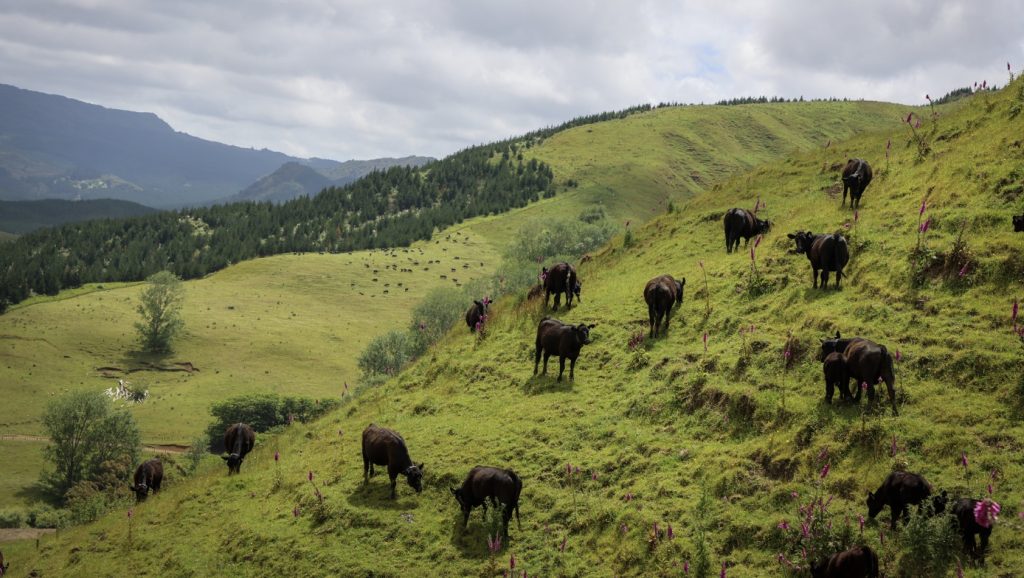
Here, the labour cost and logistics of physical shifting multiply quickly. Virtual fencing starts to make sense where access is difficult, terrain is broken or steep and mobs are spread across multiple hills and faces.
“On hill country, collars can be a genuine labour and management breakthrough, provided water and infrastructure are aligned.”
Benchmarking performance
Tom’s approach to system design starts with hard numbers, not guesswork. One of his key benchmarks is the conversion of drymatter (DM) to carcase weight (CW).
“We think that for every 20 kg DM that a farm grows, we should be able to implement a system that can convert that at 20:1. So 20 kg DM converting to 1 kg CW as a minimum.”
This benchmark is then used to guide stocking rates, rotation lengths and feed allocation from day one.
Over time, he expects more grass grown through better pasture management (e.g. pushing covers into key periods like early spring) and better utilisation and conversion efficiency which then improves the ratio beyond that initial 20:1.
When compared to more conventional systems, the difference can be stark. Tom says, in general terms, a reasonably efficient conventional system that set stocks, with a little rotational grazing through winter, has generally been able to increase that production by 50%.
“On a farm that’s growing 8 t DM/ha, we would expect to produce 400 kg CW/ha.”
Maximising success through management
Tom says intensive beef system design can see higher pasture covers at critical times (e.g. early spring) through its structured rotations instead of set-stocking.
The goal is to maximise pasture utilisation in spring when you grow the most feed. Increased stocking rate should align with the feed curve the farm can support.
“In Manawatū we used to grow half our annual production in three months. How you grow grass through the remainder of the year determines your policy options.”
He says that better matching of feed supply and demand through precise control of grazing leads to more consistent growth rates.
Wearables driving the shift of the sheep to cattle ratio in hill country
The productivity and labour advantages of systems like techno grazing are contributing to a longer-term structural land use change across New Zealand.
Tom has seen numerous farms move from sheep-dominant hill country to more of a cattle-heavy system with the roll-out of virtual fencing and wearables technology.
“The technology makes it easier to execute an intensive beef system more consistently in challenging terrain.”
The metrics Tom focuses on, such as return per unit of labour, can sometimes be a stronger validation to implement a shift in stock policy.
And, he says, it’s not just sheep under pressure for the hill, Tom believes the traditional beef cow herds are also being quietly challenged.
“I think the traditional beef cow on hill country is under real threat – not from trees, but from dairy beef. If you’re managing pasture well all year, with tools like collars, you simply don’t need a beef cow in the system the way you used to, especially when high‑quality beef animals are coming out of dairy herds.”