
Poised for a new chapter
Newly appointed Deer Industry New Zealand (DINZ) chief executive Rhys Griffiths (pictured) knows the industry has weathered some recent storms, but he believes it is poised to write the next chapter in the pioneering history of deer. Words Rebecca Greaves.

Drawing inspiration from the pioneering forebears of the deer industry, Rhys Griffiths is looking ahead to some exciting new projects and diversification in markets, as well as growing deer numbers. Despite recent challenges – Covid and its impact on the restaurant trade hit the industry particularly hard – he’s quick to point out that New Zealand remains the leading deer industry in the world.
“We’ve had our trials and tribulations … we’ve had retrenchment, but this could be phase two in the pioneering space. I think of the forefathers of our industry and what they did, and look at it with a lens of what might the next story be?”
Griffiths is no stranger to DINZ. He’s been in the deer industry for 16 years, coming up through the velvet ranks and then focusing on markets. He was interim CEO for a short while and says it’s an honour to be confirmed as the new leader of DINZ. “I’m stoked that the board has put their faith in me. We have an ambitious plan to grow the deer industry, and there are some cool projects happening,” he says with his trademark enthusiasm.
North American Retail Accelerator project
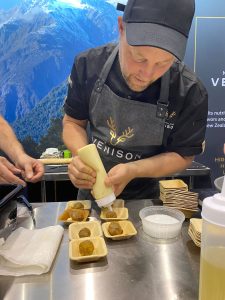
If Covid taught the industry anything, it was the need to have a more diverse market in the venison space, to not rely so heavily on the high-end restaurant trade. The move into the niche retail space in North America presents the perfect foil. Funding for the North American Retail Accelerator (NARA) project has been approved for Government funding through the Sustainable Food and Fibre
Futures programme and is supported by all five New Zealand venison processing companies.
The programme, which kicked off on July 1, commits just shy of $5 million over three years, roughly split a third from processing companies, a third from industry and a third from Government. “We had another programme through the Primary Growth Partnership, Passion2Profit, which focused on on-farm productivity and market-led initiatives. In its later stages Covid hit, and venison was overly reliant on the food service market. Overnight, the restaurants shut down, and that hit us hard, perhaps more than other proteins,” Griffiths explains. Sometimes adversity leads to innovation, he says, and venison marketers were able to pivot. Looking to the retail space in the US they saw proof of concept and strong indicators it was a good pathway to follow. Griffiths says there are two benefits. Firstly, it offers another channel diversification in market, and secondly, it presents an opportunity for a closer connection between the American consumer and the producer. “It’s great that the New Zealand provenance story is out there.”
The NARA programme aims to have $10.5m of venison going into retail annually. Griffiths says they hope to easily achieve that and have ambitions to upscale that value.
Other targets are to increase the amount of high value leg cuts from 50 tonnes up to 300t a year, to increase the amount of venison overall from 450t to 1300t/yr, to increase the number of states and provinces and retail outlets stocking New Zealand farmed venison, and to create stability for the venison market by reducing volumes sold into price sensitive commodity markets.
North America was identified as there is already a following for venison, and many of the companies had been working in the US for some time. “We had a history with Cervena, we know there is a wealthy high-paying market and there is familiarity with venison, so it ticked all the boxes.”
States identified to target for future growth include California, the New York Tri-State area and Florida.
Velvet access to China
Velvet access into China, an important market for New Zealand, has hit a road bump in recent times, but Griffiths hopes the issue can be resolved in time for this season’s velvet.
He describes it as a fluid situation and explains that in November last year, DINZ was contacted by the Ministry for Primary Industries (MPI) to inform them of the problem. “The Chinese Government had been in touch to say there was a misalignment with the way New Zealand frozen velvet was being exported to China.”
The frozen velvet is required to have a moisture content of 13% or less, so it needed to be dried rather than frozen.
Fortunately, MPI and the Chinese Government quickly agreed to allow the season, which was underway, to continue, and the focus immediately turned to finding a solution ahead of the 24/25 season. “These things can take a long time to fix, and it quickly became apparent there was a real willingness from both sides to remedy it.”
Griffiths says a new trade protocol has been agreed upon. All products exported from New Zealand need an MPI-issued health certificate, which is what they are waiting for to be approved. China is our number one exporting market for velvet, although not our largest consumer – that honour belongs to South Korea. The market has grown significantly in the last 10 years, from $30m to $120m. “The health food side in South Korea has grown really quickly,” he explains.
While two thirds of New Zealand velvet is exported to China and about one third to South Korea, roughly half of what we export to China is then processed and exported to South Korea as an ingredient product.
This means about two thirds of New Zealand velvet is consumed in South Korea.
“It’s vitally important to get this ticked off. MPI has kept us in touch every step of the way. I like to think we will look back and see this as a perfect example of a test case between government, industry and an overseas market. That’s my hope, that it will be something to be proud of. We are on the home stretch.”
Looking ahead, Griffiths sees great opportunity for velvet as an ingredient in contemporary health products in South Korea, China and further afield.
“It will help create more value we can capture, and more demand that lifts our profile, improving profitability and creating more sustainable demand for a product origin of New Zealand.”


