
From culling to live recovery
Legendary helicopter pilot and ground culler reflects on a wild time in the establishment of the deer industry. Words Dick Deaker. Photos Barry Harcourt & Garry Hollows.

How did you get into deer culling?
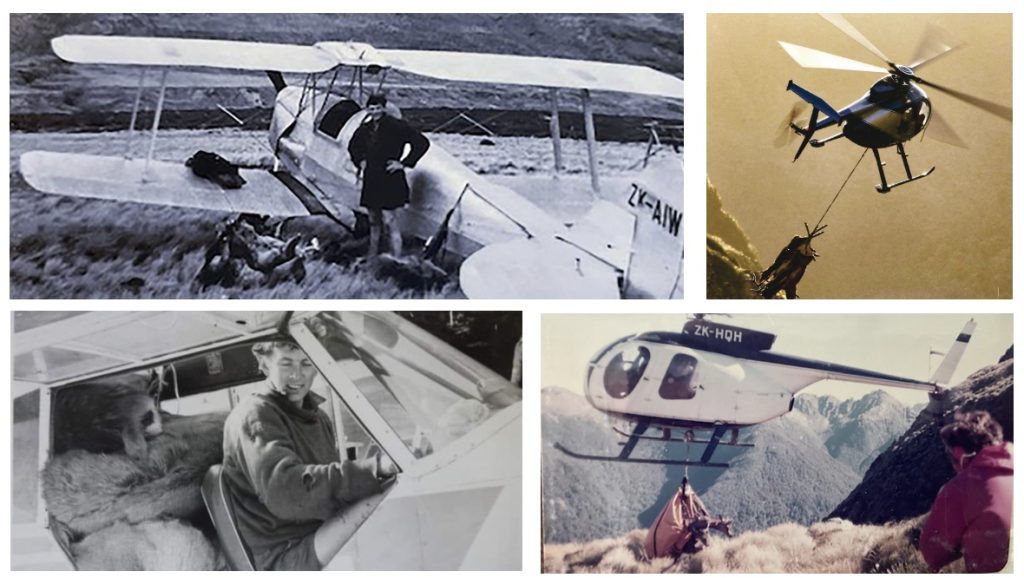
My love of hunting started as a teenager when my job was to keep my mum happy by collecting rabbits for the family stew. My brother, a mate and I used to go up the Dart Valley (in Otago) and hunt deer in the school holidays. We would get about 20 or 30 deer and sell the tails for 10 shillings each – it paid for our whole trip. Then came my interest in flying: staring out the window of Taieri High School in 1959 as the DC3 and Neptunes came in from Antartica, all I wanted to do was fly. My mother went crook at me when I wouldn’t fill in the papers to teacher’s college and jumped on a bus with a pack, sleeping bag and a .303 rifle to Queenstown to go deer culling for the Forest Service in 1964. I was sent into the Takitumu mountains where I shot about 1,000 over my first two years. At £2/deer I was making huge money. With that, I saved up to do flying lessons at the Otago Aero Club and brought my Tiger Moth which I would fly and hunt when on leave. I would have got my commercial pilot licence but I couldn’t due to a hearing problem, so I just kept ground hunting and flying as my passion.
How was it ground culling then moving to capturing deer by helicopter?
It all started when Doug Jones and Tim Wallis funded my Piper Super Cub 1969 for $5,000 for meat hunting from remote airstrips to bring back to supply the factory at Te Anau. Tim asked me if I would like to learn to fly helicopters. I was trained by Don Spary in 1972. Deer recovery by helicopter didn’t require a commercial pilot’s licence until 1974 when the regulations came in. So myself, Tim, Jim Kane and Allan Duncan sat our commercial licence until 1974 when the government changed the rules.
Don Spary spent a lot of time in Wellington and was able to get me an exemption for my hearing problem. The 1970s saw alot of helicopters around and sadly alot of avoidable accidents.
Bill Black spent alot of time hauling out loads of our deer. One day my brother Sid and I did 98 from the Caswell Sound to Te Anau. Then Tim wanted us to catch the live fawns and send them to Kay Brown’s in Te Anau and George McKay‘s at Luggate, who were raising hundreds for Tim Wallis’ fledging deer farming operation.
Tim saw more future in capturing and farming than shooting, as the numbers in the mountains were declining. We started with tranquillisers, which was frustrating work, so the net gun was developed by Ivan Wilson from Reefton and Nelson Thompson from Te Anau. You’d fly them to road ends at the Hollyford or Lake Hauroko out to a trailer where you could stand them up within the hour.
What advice do you have to conservation with the rise in deer numbers?
Deer are not everywhere like it used to be. Key areas like the valleys around Fiordland where we would shoot hundreds of deer, you’d be lucky now if you get enough for a barbecue! Search and destroy is not the answer as you’ll never get rid of them, it’s about managing the numbers. But vast areas of DOC estates have been heavily hit with 1080. You are limited where you can go to get quality deer and the good ones are heading off the hills to private high country stations to eat the crops, and farmers don’t allow ground hunters like they used to. Helicopters are a very efficient way so the government just has to pay a bit of money to subsidise that, which is probably still cheaper than the three rounds of ammo we used to get for each deer ear tip in the 1960s!


