Future-proofing beef farming
eShepherd and Auto Weigher have transformed Dion and Ali Kilmister’s farming operations into a more efficient system that they can run from afar. Words Sarah Perriam-Lampp, Photos Brad Hanson.
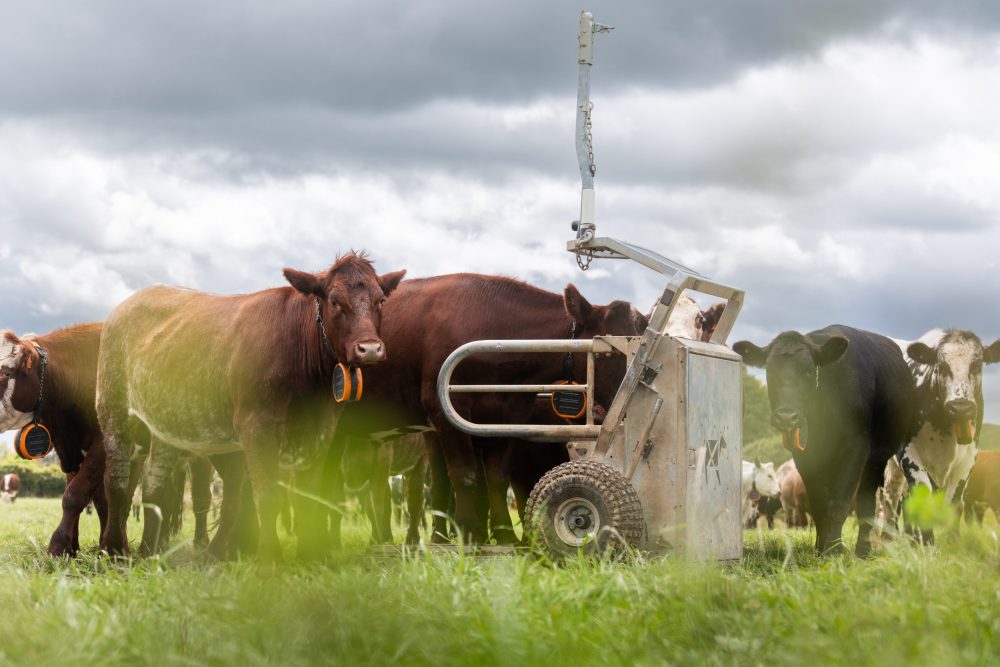
Wairarapa beef farmer, Dion Kilmister’s, last few years have been a rapid evolution in how he manages stock, pasture, and even his own time. Alongside wife Ali, he converted two ex-dairy farms into intensive beef finishing. The Kilmister’s 280 ha farm at Pahiatua, with 120 ha of flat land, 160 ha hills and a 210 ha flat property at Ekatahuna, have both become high-output, data-driven cattle finishing systems.
Central to that shift has been his adoption of Gallagher’s eShepherd virtual fencing system and the StrongBó Auto Weigher, a combination that’s fundamentally changed his business, he says.
Before eShepherd, Dion’s intensive beef system relied heavily on a standard and reel electric fence system to control grazing. It worked, but it was labour intensive and he was in need of a way to step back from the farm due to a family medical journey that took them to Australia for six months for treatment not available in New Zealand. What could have been a major disruption to the farm, instead became proof of concept for remote management.
“With the Gallagher eShepherd and Auto Weigher, I found a way to do the shifts from the Gold Coast!” he exclaims.
On the ground, farm manager, Ben White, and wife Amanda, work closely with Dion on rotations and manage the overall day-to-day operations, while Dion handles the grazing plans, setting the break shifts based on daily weight data. Dion and Ben stay in touch via WhatsApp, videos, and all other remote monitoring, including water systems on WiFi so leaks are picked up quickly too.
“I’m fully in the knowledge of what’s happening on the farm on a daily basis. I still shift the collars from the Gold Coast where we ended up buying an apartment and are here every other fortnight.”
The move to virtual fencing was driven by convenience and labour efficiency but they found the technology also turned grass into liveweight more efficiently.
Before eShepherd collars and the Auto Weigher, Dion estimates they were growing around 14 tonnes of feed, but only eating 80% of it.
“The combination of eShepherd and Auto Weigher and satellite grass measurement systems for us is about closing that gap.”
With mobs of 150–200 head of cattle shifted up to three or four times-a-day, eShepherd lets him run an intensive, dairy-style grazing system with beef cattle. Meanwhile, the Auto Weigher provides the liveweight data to prove whether it’s working.
This has become even more powerful as he moves more of his system onto summer and winter crops, where frequent shifts are essential for utilisation and are traditionally hard work. Dion recalls an example from before the Auto Weigher was installed. Dion says he also hasn’t topped a paddock since implementing eShepherd.
“We had five 18-month steers to the hectare, doing 1kg/day. We moved them onto grass when the crop was finished, weighed a month later and their weight gain had dropped to 0.3 kg. So we’d lost a whole month of liveweight gain.”
The Auto Weigher now flags those changes in near, real-time, allowing Dion to adjust feed or management immediately – whether that’s more silage, a different paddock, or a change in allocation.
One of the standout benefits for Dion is the way eShepherd and Auto Weigher ‘hold hands’ for drafting finished animals. The Auto Weigher logs each animal’s EID and weight as they stand on the scales to lick a salt block. Once certain animals hit target weights, Dion can turn off their collars in the eShepherd system.
“We can identify them, turn their collars off, and then they’ll walk out of the virtual fence, and then we can scoop them up. We don’t have to bring the whole mob in.”
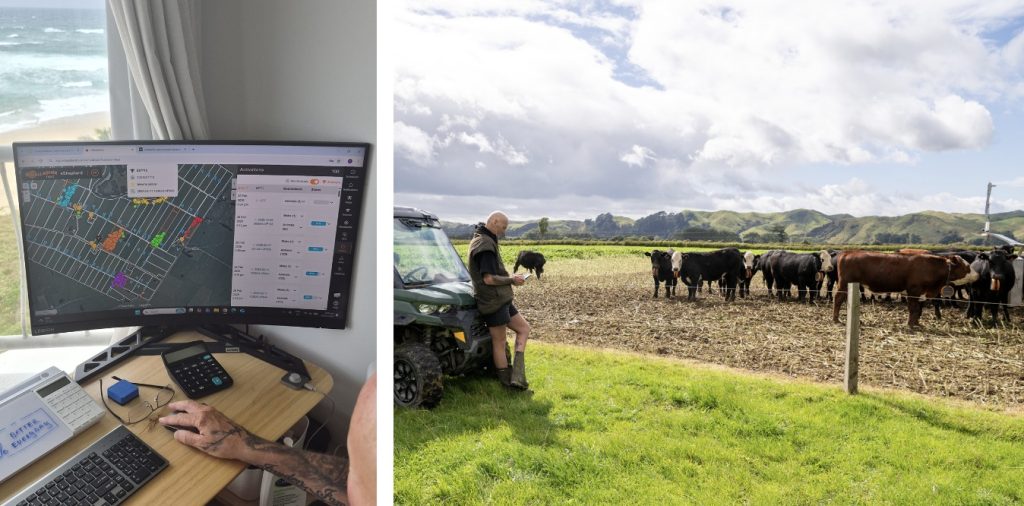
Instead of mustering 150-200 cattle through the yards, he can let only the target animals walk forward, off the break, while the rest remain behind the virtual fence. It reduces stress, labour and time and keeps the system flowing.
There’s even more potential ahead, he says, as they work towards fully linking EID tags, collars and scale data per animal.
“We’re pretty remote farming, but getting all the information on a day-to-day basis that’s required to be a good farmer.”
But Dion is clear that virtual fencing and wearables are not a replacement for good stockmanship.
“You’ve still got to make yourself go to those cattle. You’ve also got to check the collars aren’t getting too tight. So you’ve still got to be around them. Stockmanship’s still got to be there.”
Dion also states he prefers the ownership of the collars rather than leasing or subscription and really enjoys the strong backup support from Gallagher.
For him, the Gallagher tools are about amplifying good management, closing the feedback loop that traditional management often leaves open for weeks, making better real‑time grazing decisions with continuous, automated weight data and having less wasted feed.
For more information visit am.gallagher.com