Wool diversification
When Hayden and Anastasia Tristram met as medics in the army, they never imagined themselves farming, but the pull of returning to Hayden’s family farm at Wanstead eventually won out. Four years in, they are developing products to increase the value of their strong wool. By Rebecca Greaves.

As a young couple starting out in farming, Hayden and Anastasia Tristram have weathered two years of drought, followed by Cyclone Gabrielle. They reckon they must be due a good year.
Despite the challenging climatic conditions, the couple remains upbeat. They acknowledge they are just getting started and their system is a simple one with low input costs.
They do everything themselves, from dagging to fencing, and while it might be slow and involve countless weekends, they’re willing to put in the hard yards now to reap the rewards later. They also love the lifestyle and raising their young family on the farm.
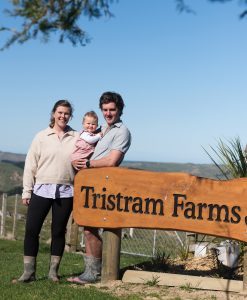
Central Hawke’s Bay.
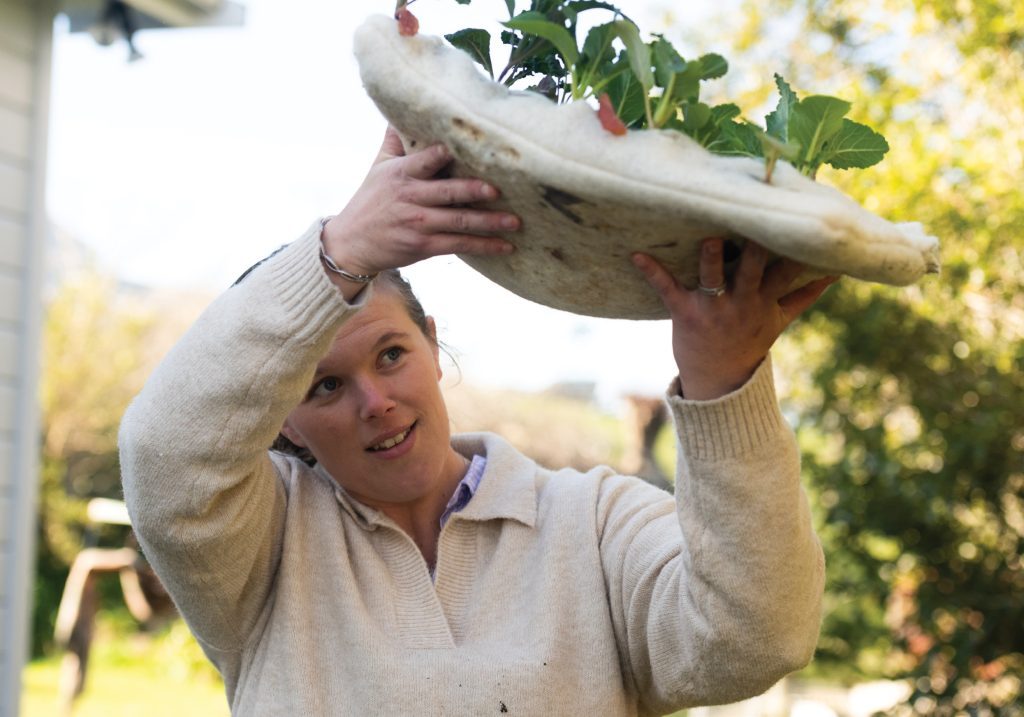
The couple has a daughter Ariella, 1, and another on the way. Anastasia, 30, is a secondary school teacher at Central Hawke’s Bay College in the nearest town, Waipukurau. She’s on maternity leave but relieves two days a week while Hayden, 29, cares for Ariella. Maternity leave has allowed Anastasia to potter away on their new venture, Floating Peaks, creating wool seed pots, seed mat and weed mat, using felted wool from their farm.
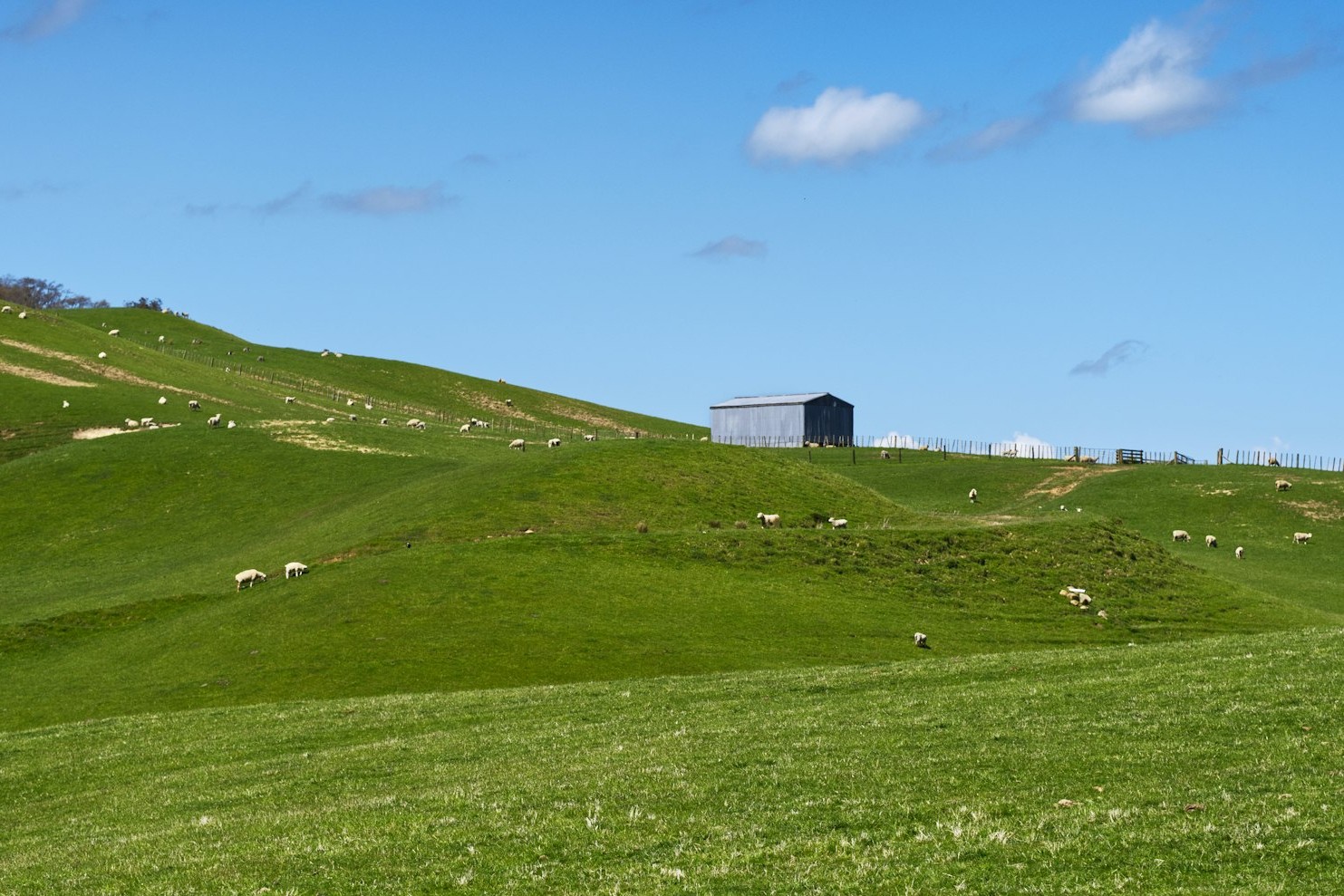
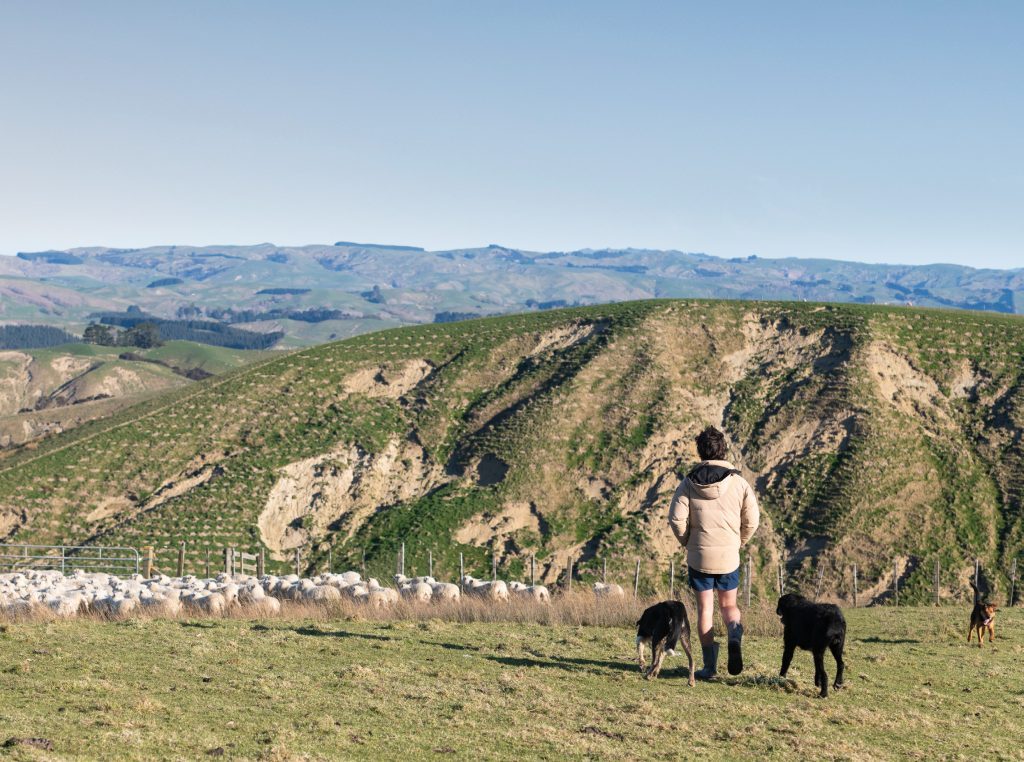
Surprisingly, Hayden admits he hated farming as a child. His parents bought the farm when he was two. An elevated sheep and beef farm with stunning views out to sea, punctuated by generous pockets of native bush, you can take a walk and find an animal to fill the freezer with venison if you’re so inclined. Most mornings they wake up to find themselves above the clouds, hence the name Floating Peaks.
Anastasia and Hayden spent eight-and-a-half years in the military, meeting while training to be medics in Christchurch. Anastasia has a Bachelor of Health Science majoring in Paramedicine. It was when the couple moved to Palmerston North and bought a house that they started to visit the family farm on weekends. Eventually, Hayden decided he wanted to give farming a crack.
“I used to hate it. As a kid you get the shit jobs like opening gates or standing in the yards filling the race. But I started coming back on weekends to help and really enjoyed it.”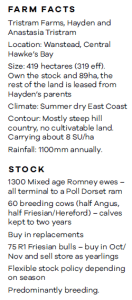
His plan was to move back in May 2018, get a few dogs going and head to Taihape to shepherd, as Anastasia was posted to Waiouru at the time, but somehow, he never left the farm.
“Dad is a builder by trade and he was building off farm. I came back and he started doing more building and pretty much left me to it.”
For Anastasia, the space and freedom compared to regimented military life, always working for someone else, has been a welcome change. “It was time for the next challenge. For us as medics, there’s only so much you can achieve in terms of what you’re trained to do.”
As a medic in the military, she loved teaching first-aid to army recruits. “I decided to focus on teaching, while Hayden chases sheep.”
She moved to the farm to rear calves in 2019 before completing a year of postgraduate study to become a teacher. The perfect job popped up at the closest college and she got the position.
Hayden’s parents have moved off farm, but his father often comes back to help, especially after the cyclone hit. In 2021 the couple purchased the stock and began leasing the farm. In March 2022 they purchased 89ha and continued to lease the rest. The plan is to slowly buy the whole property.
Keeping it simple
Hayden admits he’s still finding his feet and tries to keep his stock policies simple. The steep country lends itself to breeding; there is no cultivatable land.
The pockets of bush throughout the farm are mostly regenerating kanuka with a few beech trees.
“Our input costs are very low. It’s a simple system.”
Financials are not back for the 22/23 season, but the couple’s Farm Working Expenses were 33% of Total Farm Income for the 21/22 season.
“We don’t really have any goals as such for keeping expenses down. We just do a detailed budget at the start of each year and reallocate money depending on the year,” Anastasia says.
For example, they would normally allow $5000 for environmental planting, but this year, with cyclone damage to fix, they plan to cut that allocation to $2000. The extra $3000 will be spent on fencing materials.
“The only thing we don’t reallocate money away from is animal health. We spend whatever we have to, to ensure all animals on farm are getting all the treatment they need.”
There are 1300 mixed age Romney breeding ewes, all put to a Poll Dorset terminal ram. The ram goes out in early March.
They usually have close to 2000 lambs on the ground and dock at about 150%. Hayden says one of the strengths of the property is the ample bush and shelter, which ensures good lamb survival and low wastage. A bad year would be 20% wastage from scanning to docking.
Lambs are sold store or finished and sent to the works, depending on the season. The first cull is before Christmas, off mum, and 30–40% of lambs are sold then at about 16.5kg carcase weight before the schedule starts to drop and it gets dry.
Each month after that they will cull the tops, or if it’s dry, sell a line store.
Hayden takes a keen interest in genetics and his plan is to introduce Perendale in a bid to get a better hill country sheep, with a goal of running less sheep but holding production. “I’m playing with the cattle numbers as we are new to farming, but I want to go less sheep and go up in bulls. Sheep are labour intensive.”
They have 60 breeding cows, a mix of half Angus and half Friesian/Hereford cross. They keep all calves until two years old and they’re mostly sold store. They buy in replacements.
Finally, there are 75 R1 Friesian bulls. They buy them in early November (or they have raised their own calves in the past) at 100–120kgs and sold as yearlings – before they get destructive and start wrecking things.
The bulls are generally sold store at a target weight of 300kg in September/October (market dependent) to achieve the margin they aim for. They budget on buying weaners in at $550/head and selling them at $1000 net ($450/head gross profit). This also allows them to grow feed for the young ones due to come on.
“The first year we did it we did small numbers, reared our own calves and carried them through to two-year-olds. From a yearling they start damaging things,” Hayden says.
They rethought that approach and now buy the best quality weaners they can find, put as much weight on as possible, fast, before kicking them out to the next person before they start causing trouble. This is something that has served them well because bulls are hard to find, so demand for their animals is strong.
The bulls are grass-fed and they start to drop paddocks out of the rotation from as early as April, which leaves enough area to grow good covers and feed the bulls through winter.
This year they sold some early, as like many on the East Coast they battled with the mud post cyclone. Hayden says the bulls provide an easy stock class to bail on, building flexibility into their farming system if a lever needs to be pulled.
Weathering the storm
Like many East Coast farmers, the Tristrams woke on the morning of February 14 to find they had been visited by Cyclone Gabrielle. The damage was enormous and the repair work continues.
The couple lost about 35ha of land in the cyclone in slips (this was mapped by Ravensdown), an estimated 3–4km of fencing was gone, and most of their tracks were wiped out. Their new native riparian plantings were washed away with Gabrielle’s fury.
For the first two months Hayden was forced to go everywhere on foot to complete stock work and try to fix fences. “I’d just carry a few posts out each time.”
Anastasia says they’ve endured two droughts and the cyclone since they started farming. “But we’re surviving – we’re just waiting for that good year. We were very fortunate that Hayden’s parents are super flexible and were here to help.”
So far they’ve spent about $30,000 fixing cyclone damage and all up estimate it’ll cost about $70,000 to fix, and that’s doing all the fencing themselves. They simply can’t afford to pay someone to do it.
“We have a lot of dams that have silted up with slips, that will be the next problem, in summer,” Anastasia says.
The immediate aftermath of the cyclone was tough, added to the fact they had a small baby and Anastasia was at home and unable to help.
“I was a bit dark for a little bit,” Hayden says. “You think, what do you do, where do you start?”
“It was an unknown scenario, in your head,” Anastasia adds. “Just having a young child, sitting inside while he was out there dealing with it. I had a different responsibility and not being able to fully share the battles on the farm with him was tough.
“And then you see what’s happening in Patoka and the Esk Valley and those places and think, oh, what have we got to complain about?”
Once they had a plan, it was much easier to get started, and Hayden’s parents were quickly on deck to help, too.
“In an ironic kind of way, it’s pretty impressive, the damage,” he says.
Wonderful wool
Not content to accept the rock-bottom prices he was receiving for his strong wool, Hayden was always tossing ideas around – what could they do with it to add value?
“I don’t even know how we got on to felting, but I had some ewe wool in the shed and one day I thought, let’s just do it.”
He loaded two bales onto his trailer and drove it to Woolworks wool scouring in Napier where he had it felted for the grand sum of $3000. He had no clue what to make with it and no firm business plan.
“I’ve always wanted to make pots and I guess that’s how we went down that road,” Hayden says.
If all else failed, they reasoned they could use it as weed mat on the farm. “A lady at school taught me to sew, and I taught Hayden. Now we can sew in straight lines,” Anastasia says with a laugh. A spare room at the front of their home has been converted to a workshop, fondly referred to as the sweatshop.
Just over a year ago the sweatshop started production and Floating Peaks was born. The timing was perfect as it gave Anastasia something to do while on maternity leave.
When Ariella was just five weeks old, they attended their first market day – cash sales, no branding – and it was a huge success. Encouraged, they decided to carry on with the seed pots and the product range grew from there.
Peak Pots are 100% felt-wool pots, which come in three different styles and two sizes, and Peak Beds are felt-wool seed beds that you fill with soil and sow your seeds directly into. Because the roots are able to penetrate and grow down through the wool, the beds and pots are able to be planted directly into the ground.
The Peak Pack is a gift pack with the tagline “your 100% growing experience with wool”. It includes seeds, a Peak Bed and Peak Pots. They also make weed mat from recycled wool (not made from their own wool).
Anastasia says Woolworks has been on board from the start. “Nothing has been a problem. Hayden just rocked up with his little trailer like, ‘hey guys’, and they helped us. They have been really supportive, and they were the first to buy our products.”
At the moment, the venture is small. Going to markets gets them off farm and allows them to share their farming story with others.
“It would be silly to think we would make big money selling wool pots. But for us there’s something about having your own wool and being able to present it to someone, have them take it and make something of their own. It’s pretty special.”
As a teacher, Anastasia can see that selling wool comes down to education. She identified a gap in the market and approached the Campaign for Wool about developing a resource to be used in schools, educating children about wool.
She has created a workbook ‘The Wool Journey’ with funding from Woolworks, that takes students from the paddock to the product. The workbook is supported by videos, currently being filmed. These include mustering and dogs working with sheep, shearing and the scouring process. At the end, students make their own wool pot to take home and continue the conversation. They also get a greasy wool sample to get their hands dirty and learn about lanolin.
The resource will be trialled in schools in Term 4 and is suitable for Curriculum Level 3, covering literacy, numeracy and reading comprehension. Anastasia’s dream is to fully fund the resource and make it free for schools.
The Wool Journey is Anastasia’s passion product while the pots and mats are a side hustle. The production cost is low; they don’t account for their time. “We just potter at night and don’t count our time as an expense. We get so much enjoyment from the markets. Our passion is more about education and, because I’m on maternity leave, I can justify the time invested in it.”
They sell a pack of three pots for $10, and make a margin, but they know it’s not a long-term money maker.
They may not make it big with wool pots, but the Tristrams do have an exciting wool product being trialled on 17 farms across New Zealand. If successful, it could be a game changer and make a real difference in the wool industry. Details are under wraps, but watch this space. This dynamic duo is on a mission to help restore strong wool to its former glory.