Taking hogget performance to the next level
A Southland group of farmers aim to be lambing 150% in their hoggets without compromising the ewes’ two-tooth performance or longevity. Words Sandra Taylor

When Geordie Eade returned to the family farm in 2002, he thought it would be a great idea to pay his wages out of the money made from hogget lambing.
This meant he wouldn’t be costing his parents any money.
This bold move motivated the young farmer to better understand the drivers behind successful hogget mating and lambing, and within two years he was generating a respectable income.
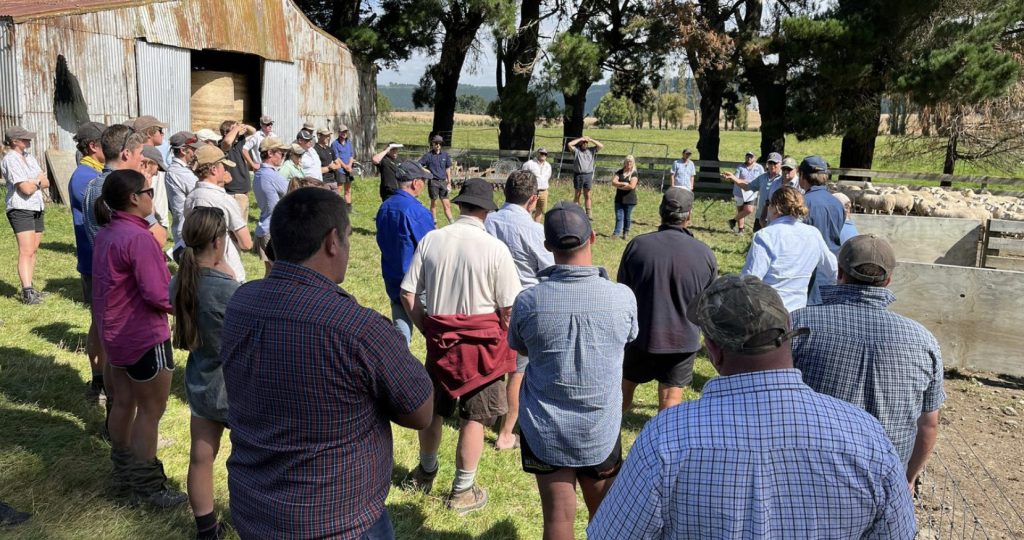
Twenty-three years later, he is still working on lifting the performance of his hoggets and is a member of the Hogget 150 Action Group. Speaking at a recent Beef + Lamb New Zealand field day, Hogget 150 Comes to Canterbury, Hogget 150 member Pete Thomson said he is already scanning over 150% in his hoggets and believes with the right tools, he, and other group members, will be lambing 150% in their hoggets within their farming career.
Most importantly, all members have seen a significant lift in the overall efficiency of their sheep flock due to this focus on hogget lambing, but they stress that it is important to get the management right.
“It’s a high-performance system, so it’s important to get the jobs done at the right time,” says Geordie and Pete. While all Hogget 150 members are running high-performance operations, they are all running low-input systems, with a focus on maintaining pasture quality to drive growth rates throughout that critical first year of the replacement ewe lamb’s life.
Hogget 150 was formed in 2019 as a Red Meat Profit Partnership Action Group. It is made up of 10 farmers from across Southland and South Otago representing a wide range of farm types and environments.
Members run between 500 and 2,000 hoggets, all of which are either a Romney/Coopworth-based composite/crossbreed with some Texel.
Last year, the group put together a list of the management strategies they believe are critical to successful hogget mating and reproductive performance.
1. Selection, shearing and the use of teasers
At the end of January or in early February, the majority of members select replacement ewe lambs from their twin and triplet mobs, sending the heavier singles for processing. They do however select the heavier multiple lambs (a minimum of 35kg LW if possible) and will also select on type and in some cases, dag score.
They have found shearing replacement lambs in mid-February helps drive growth rates, but they will also preferentially feed the bottom-end lambs.
Immediately after shearing they put teaser rams, or rams with a no-mate harness, out at a ratio of 1:100–200 for around 60 days. This is around three times longer than the recommended
17 days.
They have all found ovulation rates increase significantly in the third and fourth cycle – hence leaving the teaser out for an extended period. Geordie tried going back to only using the teaser for 17 days, but his scanning percentage fell by 20%.
2. Mating management
At the end of March, they cull any ewe lambs that are under 40kg LW and by mid-April, any ewe lambs not weighing a minimum of 45kg will also be culled. Most of the group is aiming to have their ewe lambs weighing an average 50kg at mating and to achieve this, the lambs need to be growing at 350–400g/day over summer.
A week before the ram goes out, they back off the feeding by running the ewe lambs behind a wire.
They have experienced problems with conception or pregnancy retention if the lambs are continuing to grow quickly over mating. The majority of members use a Dorper-cross ram over their hoggets. While they have all tried different breeds, they have found they have minimal lambing problems with the Dorper-cross rams. The resulting lambs are also extremely hardy and aggressive feeders with high survivability. Geordie says they will happily drink off other ewes.
3. Driving winter growth rates – forage crops won’t work.
All the group’s members winter their hoggets on grass, typically on daily shifts. Geordie says the hoggets need to be growing at least 120g/day throughout winter and they have found this is surprisingly difficult to achieve.
“You’re not going to achieve these growth rates on swedes or brassicas.”
A trial carried out one winter found only one-third of the group’s members were achieving their target growth rates, although all assumed they were.
“Fifty kilograms is the magic weight.” – Pete Thomson, Winton, Southland
Some members have elected to winter their capital ewes on forage crops and keep their hoggets on grass to help keep them growing over winter. This is opposite of what they had traditionally been doing.
Pete Thomson does winter his single-bearing hoggets on high-quality leafy kale, but multiple-bearing hoggets need to be fed as well as possible on quality pasture, typically on daily shifts.
Dry hoggets are sold at scanning, although they are finding they have very few dry hoggets.
Last year, out of 900 hoggets, Pete Thomson only had 46 dry hoggets or 5% of the flock.
4. Lambing
In August, most of the group’s members either pre-lamb shear (using a cover-comb) or belly-crutch their hoggets. Pete says he has tried not shearing or crutching, but wouldn’t do it again.
The following month the hoggets are given a five-in-one vaccination and a long-acting drench. The latter is particularly important.
The twin-bearing hoggets are preferentially fed while the single-bearing hoggets are kept behind a wire in the lead-up to lambing and at lambing, the twin-bearing hoggets are set-stocked in well-sheltered paddocks.
Geordie says shelter is particularly important as hogget lambs tend to be around half a kilo lighter than the lambs from the mixed-age ewes.
The group have found that thanks to the use of teaser rams, 70% of their hoggets will lamb within the first 10 days of lambing.
“Last year, the average weaning weight of our twin hogget lambs was 27kg while half the singles were sold prime and processed at 17.1kg CW.” – Geordie Eade, Riverton, Southland
5. Pasture management
To keep both the hoggets and their offspring growing over spring, it is critical to maintain pasture quality over October and November.
The group considers cattle to be an important component of a successful hogget mating system for both pasture quality and worm control.
6. Weaning
All the Hogget 150 members aim to wean the twin hogget lambs before Christmas and some will leave the single lambs on for a bit longer and sell these lambs prime at weaning.
In January, the hoggets are body condition scored and managed accordingly. Where necessary, lighter hoggets are drenched. This ensures the two-tooths are going to the ram in optimal condition.
7. Impact on the farm system
All members have reduced ewe numbers to accommodate improved hogget productivity, but the overall outcome has been more lambs born across the whole flock. It is, says Geordie and Pete, a much more efficient system as they are producing more lambs from fewer capital stock.
This has had a positive impact on the bottom line and last year, all Hogget 150 members made a profit in what was an economically challenging year for sheep and beef farmers.
Geordie doesn’t believe hogget lambing has any negative impacts on ewe longevity and he has eight- and nine-year-old ewes in his flock.