Doing the little things right
Always wondered what the secret is behind a record-breaking maize crop? Waikato brothers Donald and Craig Stobie, who broke the national Pioneer maize grain yield record in 2025, say that big yields come from doing the little things right, following good advice and planting the right hybrid. Words Sarah Perriam-Lampp.
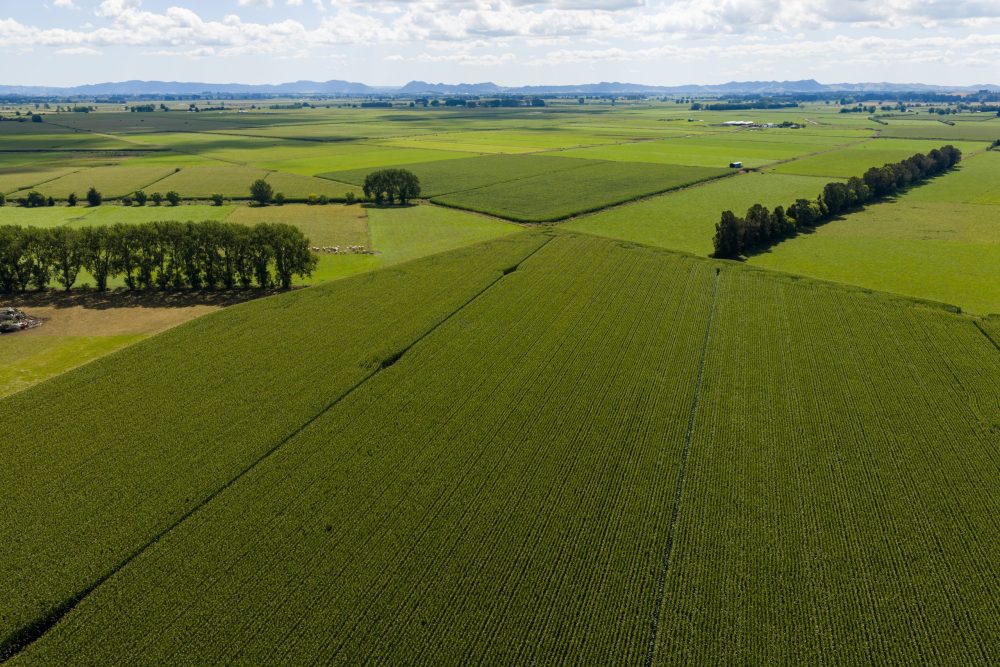
When the maize grain came off the Stobies’ competition paddock in 2025, it weighed in at 24.5t/ha – winning the Pioneer Maize Grain Competition, claiming the Paul Baker Yield Cup and breaking the national record of 23.41t/ha set by Gisborne grower Tom Newman in 2022. The commercial grain area averaged a healthy 18t/ha in the same season.
For Waikato maize growers Donald and Craig Stobie, the record was no fluke, just attention to detail, repeated across every paddock and every season.
The Stobie family partnership – Donald, his wife Brenda, brother Craig and their parents, Duncan and Loraine – farm 445ha of peat soils at Gordonton near Hamilton. Each year, they grow about 200ha of maize, with about 80ha harvested for grain and the balance taken as silage, a crop that has anchored the system for three decades since Duncan began growing it to sell to local dairy farmers.
“We’ve been growing maize silage for about 31 years now, so maize has become a really important part of our system,” says Donald. “This will be our 12th maize grain harvest.”
Growing both grain and silage gives the family flexibility, with end use able to shift with seasonal conditions, market demand and price. Around two-thirds of his area is planted in maize silage and the remaining third in maize grain, giving him a built-in buffer to adjust to market conditions. In the most recent season, he harvested 29.2 tonnes of silage per hectare, with a typical long‑term average in the 27.5-28 t DM/ha range, reflecting both strong growing conditions and disciplined crop management.
For Donald, producing both high yields and quality silage starts with choosing the right hybrids to match his local growing conditions, then executing the basics consistently well. He focuses on good weed control, adequate fertiliser programmes and leans on advice from his Pioneer representative to fine‑tune hybrid choice and agronomy. On the marketing side, he prefers to contract with the same repeat customers at planting time each spring so he has early certainty on the area required for silage and can swing a little more land into grain or silage depending on demand and how the season unfolds for his dairy clients.
“We’ve had a long-term relationship with Pioneer. Pioneer seed quality is always very good and their backup and support are second to none.” – Donald Stobie, Gordonton
Maize grain also diversifies income, spreads workload through the year and doubles as a development and regrassing tool. Grain comes off from late April to early May, and each winter about 6,000 lambs are bought in and finished on the maize ground from May to September – winter income, continuous cover and paddocks left in good order for the next crop.
It all starts with the seedbed. Permanent or annual pasture is sprayed out and left to fallow for about two weeks to let roots break down, followed by a first pass with the chisel plough and power-harrowing ahead of planting – chasing accurate depth control, uniform emergence and strong early vigour.
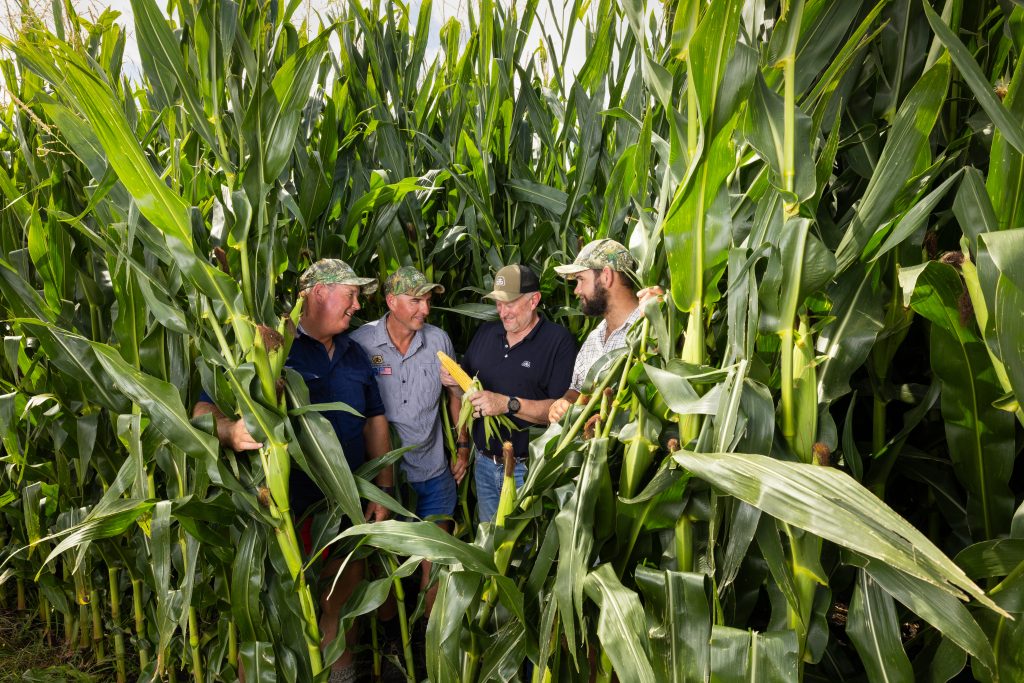
“Once we are in that window, we plant as soon as conditions allow it,” says Donald of the mid- to late-October optimum, with timing dictated strictly by conditions rather than the calendar. A local contractor plants at populations of 85,000-105,000 seeds/ha, adjusted to paddock conditions and yield potential.
With paddocks averaging just 1.8ha, variability was the handbrake on whole-farm averages, so the family invested in drainage, contouring and capital fertiliser to lift the weak zones rather than chase marginal gains in strong ones.
Nutrient management is built on measurement, not fixed programmes. The farm is divided into 22 management blocks, soil tested annually in late August so decisions are made well ahead of spring. An independent advisor guides base fertiliser, while nitrogen is split between starter fertiliser and side-dressed urea knifed in later to improve efficiency. A strong pre-emergence herbicide programme is followed by paddock-by-paddock post-emergence calls.
“Once you’ve invested that much in a crop, it doesn’t make sense to let weeds take yield away,” says Donald.
Hybrid selection for the Stobies is driven by resilience as much as yield.
“A cyclone in February is what an unfavourable season looks like. Wind damage, lodging or complete crop loss is largely out of our control, but choosing the right hybrid can help.”
In the 2025-26 season, the family planted Pioneer brand P0710, P0900 and P0937 for grain, and P1636 and P1185 for silage with P1185 the hybrid behind the record-breaking entry.
“We’re looking for a strong, healthy plant with good disease resistance and the ability to yield when conditions allow but still perform in abnormal or unfavourable seasons.”
Visit pioneer.co.nz