Designing agricultural policy for a future in farming
New Zealand farmers face significant challenges reconciling environmental regulations with economic realities. Kerry Worsnop’s 2023 Nuffield report The mountain we need to climb – designing agricultural policy for a future in farming addresses those in leadership, agricultural policy makers and others with an interest in how we deliver better outcomes for those on the land and for the land itself.

New Zealand has a legacy of leadership, pioneering and innovating in the face of challenges, and culturally we are often eager to ‘lead the way’. However, we are less accomplished at reviewing ourselves objectively and understanding what about our leadership or innovations have proven effective,
or where we have gone astray. This means that our perspective regarding what we do, how, and why we do it sometimes lacks clarity, Worsnop noted in her report.
“This report hopes to bring into focus some of what we must clearly comprehend about ourselves and our operating environment if we are to navigate agricultural policy more successfully going forward.”
Understanding the present – by looking to our past
New Zealand’s agricultural evolution is a tale of transformation and adaptation. From its colonial days, when governors sought a means of expanding the income streams of government via the alienation, lease and sale of Māori land to support pastoral farming; to its current state, the journey has been marked by shifts in policy and economic strategy. Initially, the land was used for flax and timber, but government policies soon directed it towards pastoral farming to boost revenue, stimulate economic growth and establish ideal settlement patterns.
In the post-World War II era, New Zealand emerged as one of the wealthiest nations by Gross Domestic Product (GDP) per capita. However, by the 1970s and 1980s, its agricultural sector had become heavily reliant on subsidies, with over 30% of farm income dependent on government support. The Fourth Labour Government’s reforms in 1984 marked a radical shift towards free-market principles and deregulation, designed to address the unsustainable nature of these subsidies and refocus agricultural policy on market efficiency and productivity. Today, New Zealand’s agricultural sector operates within a deregulated market environment, diverging significantly from international practices. While global trends increasingly emphasise environmental sustainability, New Zealand has struggled with a fragmented approach. Farmers have adjusted to market-driven strategies rather than relying on subsidies, and although environmental regulations and project-based funding have increased, there remains a notable lack of comprehensive financial support.
The Winds of Change
The movement toward environmental stewardship in New Zealand has been gradual. Early recognition of the need for improved environmental practices was not matched by practical advancements, partly due to complex regulations that have alienated farmers from policymakers. European countries have leveraged extensive incentive programmes to promote environmental practices, but New Zealand’s fragmented approach has led to a disconnect between regulatory expectations and agricultural practices.
Seeing the Bull (Elephants) in the Room
Market signals have a profound impact on agricultural practices in New Zealand, often more so than in many comparable countries. Although there is consumer demand for sustainably produced products, this seldom translates into significant environmental change due to competing priorities and financial constraints. Research and interviews reveal that neither market mechanisms nor regulation alone can drive substantial environmental improvements.
For instance, Jonathan Baker of The Department for Environment, Food and Rural Affairs (DEFRA) in the UK highlights that while regulations can mitigate negative impacts, they don’t necessarily ensure positive environmental outcomes. Market premiums for environmental stewardship in Europe are often inadequate, serving more as marketing tools than effective measures. The global focus on inflation and cost-of-living crises further complicates consumers’ ability to prioritise higher-priced, environmentally friendly products.
New Zealand farmers, operating without subsidies, face similar challenges. They are keen to invest in environmental practices but are often held back by financial constraints, which leads them to delay such investments.
The Unique Risks for New Zealand Farmers
New Zealand’s farmers confront unique risks due to limited financial buffers and risk management tools. Historically, they managed resilience independently, but now face stricter environmental regulations without the financial support available to their international counterparts. Unlike farmers in countries like England, Ireland, and Canada, who benefit from various policy tools
and protections, New Zealand’s deregulated market and stringent controls impose high costs without adequate financial compensation.
The Mountain We Need to Climb – Integrating Environmental Change with Regulation
New Zealand faces a significant challenge in improving environmental outcomes solely through regulation. Globally, there is consensus that regulation alone is insufficient for driving extensive changes in land management and environmental policy. Martin Jenkins from DEFRA notes that strict regulations often lead to resistance from farmers and require costly enforcement. Richard King from the Anderson Centre supports this view, emphasising the high costs and potential ineffectiveness of enforcement measures.
Countries like the Netherlands and Ireland have invested significantly in supporting environmental transitions. The Netherlands allocated twenty-five billion euros to support agricultural changes, while Ireland uses payments to balance environmental goals with farmers’ benefits. This financial support helps mitigate the impact of regulatory changes on farmers. New Zealand’s lack of financial support for farmers places them at a disadvantage, as they face rising regulatory costs without corresponding market incentives.
The Blame Game and Policy Challenges
The post-deregulation era in New Zealand has fostered a politically charged environment with fluctuating policies and limited consensus on agricultural and environmental management. This instability creates a reactive cycle that hinders investment and innovation. Historical deregulation and economic booms, such as the dairy expansion of the late 90s, have led to a disconnect between policy intent and practical outcomes.
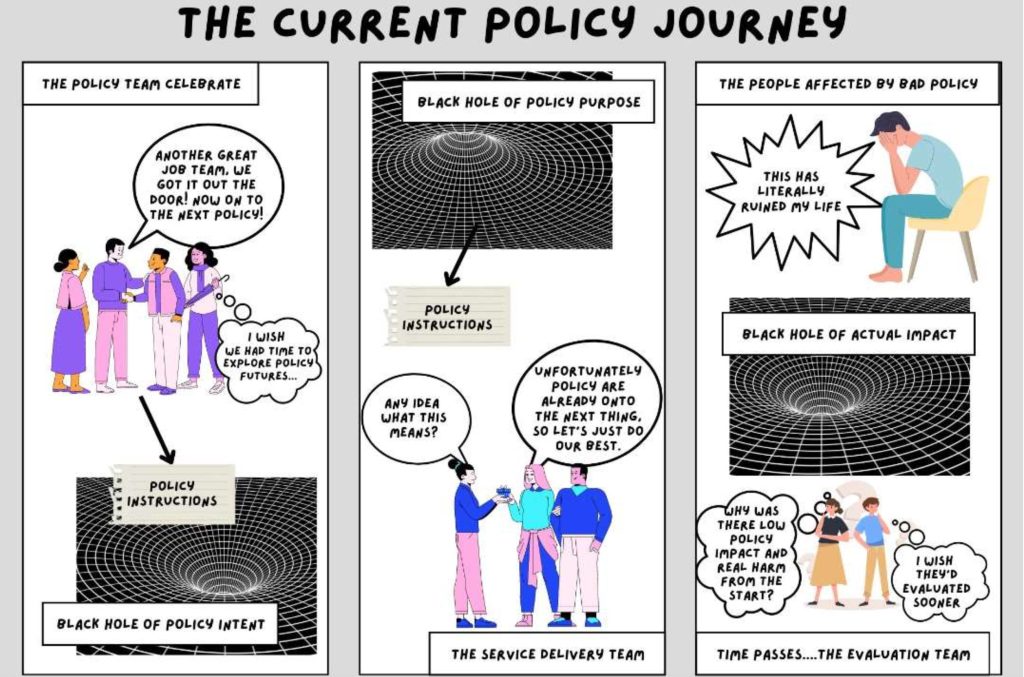
As awareness of water quality issues increased, the focus shifted from economic productivity to environmental concerns. This shift, combined with rising public and political pressure, has created a contentious environment where policy changes are frequent and often poorly executed. The government’s 2020 “Fit for Better World” roadmap and other initiatives have struggled to effectively engage grassroots stakeholders.
Farmers face significant challenges reconciling environmental regulations with economic realities. The disconnect between policymakers and those affected by regulations has resulted in ineffective implementation and frustration. The metaphor of the mountain illustrates the challenge of integrating diverse perspectives in policy making. Climbing the mountain symbolises the collective effort
required to understand and address complex challenges.
Chart the Course – Current Approaches to Complex Problems
Modern democratic systems often rely on outdated command-and-control methods to address complex policy issues, resulting in the failure of recent initiatives. These methods, characterised by binary solutions and narrow scopes, lead to short-lived and poorly considered outcomes.
“New Zealand faces a significant challenge in improving environmental outcomes solely through regulation. Globally, there is consensus that regulation alone is insufficient for driving extensive changes in land management and environmental policy.” – Kerry Worsnop, Nuffield scholar
The downfall of the Dutch government exemplifies the consequences of such approaches, where electoral pressures and the need for rapid responses exacerbate policy issues and create a disconnect between intent and outcomes.
Advocating More Effective Approaches
Research shows the need for more effective policy design. Effective policy must consider human values, conflicts, and characteristics, requiring a comprehensive understanding of causation and values to create coherent interventions. New Zealand’s agricultural policy landscape needs to move beyond linear processes toward a dynamic, feedback-driven approach.
Barriers to Effective Policy Design
Several barriers impede the shift to more effective policy approaches:
- Political Will: There is often a lack of sustained commitment to long-term solutions due to public demand for immediate results. Frequent election cycles and ministerial changes exacerbate this issue.
- Resourcing: The scale and urgency
of problems overwhelm public leaders, leading to a shortage of resources for organisational change, expertise, and continuity. - The Spotlight: Agriculture’s economic and environmental impact results in intense political scrutiny, leading to polarised views and policy swings that undermine stable solutions.
- Language: Effective policy design requires clear communication and understanding among stakeholders. A lack of shared language and engagement leads to gaps in insight and implementation.
Emerging Clues and Opportunities
The Public Service Act 2020 reflects an understanding of these barriers by emphasising flexibility, inter-departmental collaboration, and agile service delivery. Recent findings suggest focusing on adopting common frameworks, innovative approaches, and collaborative practices. Participatory approaches, such as Ireland’s citizens’ assembly for abortion law reform, illustrate the potential for more effective policymaking.
The Pulse of Change
Despite efforts to integrate design thinking into public policy, results are often inconclusive. Innovation labs and design-led approaches face resistance due to entrenched hierarchical and risk-averse structures in the public sector. These labs, while offering alternative working methods, struggle with political and administrative pressures favouring short-term results over long-term change.
New Zealand’s Potential for Change
New Zealand’s stable political environment and adaptive history present an opportunity for policy innovation. The readiness for substantive change among public servants and society highlights the potential for reform. Achieving this requires overcoming entrenched resistance to systemic change and committing to collaborative, people-centred policy design. By embracing these principles, New Zealand can address complex issues more effectively and build a more responsive public service.
Light the Way – The British Case Study: Challenges and Innovations
The UK’s exit from the EU in 2016 required a major overhaul of its agricultural policies due to the loss of Common Agricultural Policy payments, critical for 65% of British farmers. This upheaval created significant uncertainty as policymakers and farmers grappled with the dual challenge of losing subsidies and developing new policies. The UK’s Future Farming and Countryside Programme, under Janet Hughes, adopted a co-design approach involving stakeholders from the outset. This approach aimed to address systemic issues by ensuring policies were practical and responsive to farmers’ needs.
Despite initial resistance and challenges, the programme’s emphasis on transparency, communication, and iterative development marked a significant departure from traditional policy methods. This approach showed promise in addressing complex issues through collaborative and adaptive strategies.
The New Zealand Case Study: Iterative Policy Development
New Zealand’s One Billion Trees scheme, launched in 2018, contrasts with more rigid policy frameworks. Initially lacking detailed planning, the scheme faced scrutiny but evolved through iterative development. Feedback from iwi, foresters, and farmers led to adjustments that improved implementation. This flexibility highlighted the benefits of an adaptive approach, contrasting with the rigidity of New Zealand’s Emissions Trading Scheme, which struggled to adjust in response to new evidence.
The success of the One Billion Trees scheme underscores the value of iterative policy development and stakeholder engagement in creating effective and sustainable policies.
Conclusions
Reconciling New Zealand’s agricultural and environmental goals is challenging due to its reliance on regulation and market forces, often leading to conflicting objectives. The current approach, constrained by historical deregulation and limited policy tools, necessitates exploring new frameworks.
The report advocates for expanding the policy framework beyond traditional mechanisms by integrating systemic and human-centred design approaches.
Recommendations include building consensus on the need for change, recognising the importance of clear communication, investing in trust-building, and defending the space for systemic design.
Addressing these challenges requires a more integrated and thoughtful approach to policy development, bridging the gap between stated values and practical outcomes.
To download the full report, go to the Rural Leaders website and head to the Scholar reports section on the Nuffield tab. ruralleaders.co.nz/the-mountain-we-need-to-climb-designing-agricultural-policy-for-a-future-in-farming/