Beyond the boom
As arable and pastoral farming face a chemical-light future, a Swiss precision technology has AI sprayers already in use in Canterbury and Pukekohe, slashing chemical use by 80-90% and improving yields. Words Sarah Perriam-Lampp.
Weather events have been brutal for arable farmers this season with some growers sustaining multi-million dollar losses with high-value crops left rotting such as specialty small seed. But also winter feed yields on pastoral farms have been back in places too.
Grant Reith of Reith Agri Imports in Ashburton has seen the intense pressure on arable growers after this season.
At Reith Agri Imports, a company founded 37 years ago (starting as New Zealand Tractors), their core business has always been driven by client inquiry and a commitment to direct-to-farmer solutions.
“We had demand from farmers to look into Ecorobotix, a Swiss-based, ultra-high-precision spot sprayer technology and we were the first in the Southern Hemisphere to become the distributor.”
“When farmers do the maths, the investment becomes a no-brainer.” – Grant Reith, Reith Agri Imports, Ashburton
He says the primary driver for this technology is not just a looming chemical resistance problem but a demand fueled by the strong consumer desire to reduce reliance on agricultural chemicals. Ecorobotix technology uses advanced AI and computer vision to target individual plants, applying foliar fertiliser or applying a targeted chemical application specifically to the weed. This spot application is delivering game-changing results.
“Across New Zealand, our clients are consistently reporting an 80% to 90% reduction in chemical usage while maintaining, or even improving, good results.”
For instance there is a reported 10–15% increase in yield in onions to due to reduced crop stress and phytotoxicity.
While the technology is powerful in the vegetable and seed sectors, with carrot and onion algorithms being some of the strongest, its utility extends across pastoral and amenity land use.
He says the Ecorobotix sprayer is proving incredibly useful in pasture management.
“We’ve seen outstanding results treating difficult weeds like docks and thistles. By using a strong, targeted chemical, the system blows the weed out of the ground, while clover and plantains right beside it remain untouched.”
This is critical, as it means the farmer is not taking their paddock out of production.
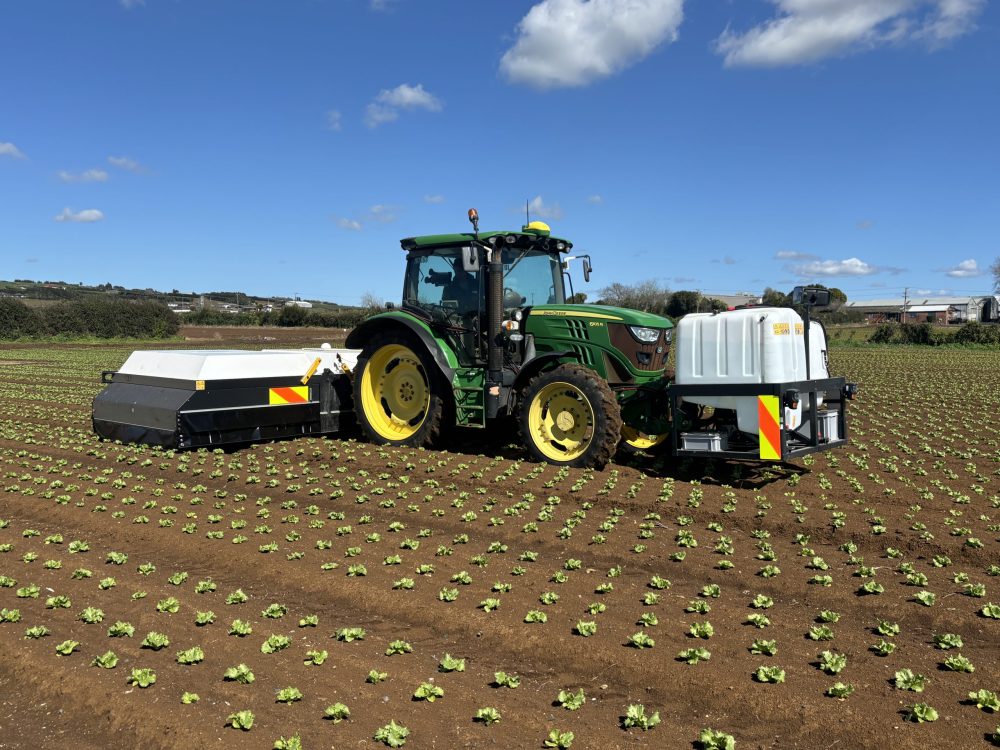
The Ecorobotix ARA field sprayer is a mounted unit that’s 6.2 metres wide and can spray a 6 cm by 6 cm square area while moving at 7.2 kilometers per hour.
It has more than 25 algorithms as well as general features like spraying based on row width, plant colour, or plant size. The technology even includes a thinning algorithm for high-value vegetable crops like lettuce, allowing growers to plant from seed and thin the crop perfectly to a specified spacing, drastically reducing transplanting costs.
Recognising public perception around spraying, Ecorobotix has also released the new ALBA model, which targets the turf market, including sports fields, golf courses and parks.
“When farmers do the maths, the investment becomes a no-brainer.”
Grant says the real calculation is not solely the cost of chemical reduction, but the lost production value from the weed infestation itself. He gives an example that if a paddock has 10% dock coverage, the farmer is losing 10% of their production value.
What Grant likes about Ecorobotix is it’s not a startup experiment. With over 200 employees and operations globally, Ecorobotix is backed by major entities, who recognise this technology as the future.
“We currently have five machines active in New Zealand from becoming the sole distributor less than a year ago – from Timaru to Pukekohe – logging nearly 3,400 hectares and a variety of crops (fresh produce, seed and pastures).”
He views their local support infrastructure as a key differentiator in the market, Ecorobotix commitment is there.
The other thing Grant likes about Ecorobotix is that they understand New Zealand’s agricultural diversity compared with other countries and that as a country we grow many different varieties of high-value vegetable seed to large-scale pasture crops.
“Ecorobotix is not static. They are constantly innovating with new algorithms under development ensuring the technology remains cutting-edge for the New Zealand farming context.”