Tracking weight gain without leaving the paddock
An Australian-designed paddock weighing system is scaling up in New Zealand, supporting sheep farmers to measure weight gain without leaving the paddock. Words Sarah Perriam-Lampp.
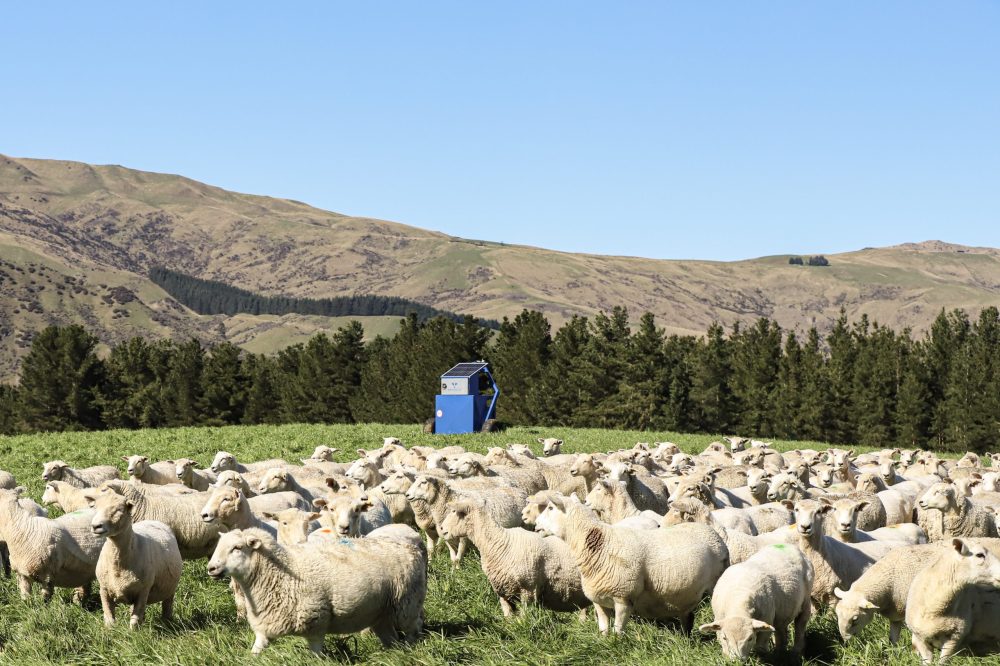
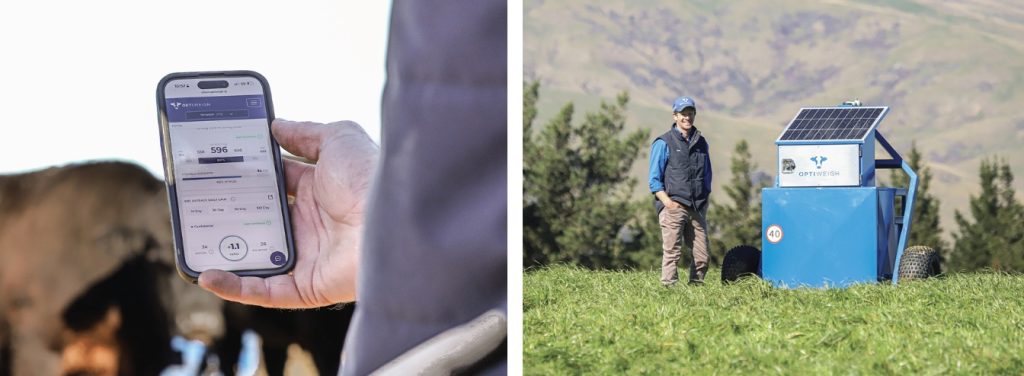
A ewe hogget in a Canterbury paddock is being weighed today right where it licks a salt block, with its weight being read in real time on a phone app, all without being mustered off feed and drafted through the yards. Front-foot in-paddock weighing technology has been rising in popularity among beef and dairy farmers looking to measure, monitor and improve weight gain and is now being used among New Zealand sheep farmers.
Optiweigh is a precision livestock technology founded seven years ago by Bill and Jacqui Mitchell in Armidale, New South Wales, with an Australian based team that handles manufacturing, software and support. Nearly 2,000 units are in use across Australia and four other continents, in both sheep and cattle models. Scott Higgins grew up in North Canterbury and had spent six years in Tasmania before returning home in January to build the New Zealand market for Optiweigh.
“My old man said, if you travel overseas after university, make sure you bring some great ideas home. I saw Optiweigh and thought this is the future for lifting the profitability of sheep farming,” explains Scott, now based in Rangiora with fiancé Emma Subtil.
Electronic identification (EID) tags are being phased into Australia as compulsory by 2027 for biosecurity reasons in prevention of diseases. Whilst it remains voluntary for New Zealand sheep farmers, the benefits Scott has seen in Australia are not just improving traceability through an EID tag but what individual identification can unlock for decision making.
“It’s all well and good to graze your covers down and have very low residuals,” he says. “But what’s the liveweight gain you’re getting out of grazing that paddock hard?”
The current way to monitor weight gain more accurately than by eye is by bringing the mob into the yards and drafting off the outliers to priority feed or cull. The Optiweigh system allows farmers to remotely check into a mob’s performance daily and then make decisions on moving breaks fences or shifting paddocks based on a mob average.
“While Optiweigh gives a very accurate mob average and weight distribution without having EID tags, the advantage of having them is the ability to look at individual animal performance,” Scott says. “Even without weighing the entire mob, the EID data can provide critical information about the variability of performance between animals.”
The clear payback
Scott explains that while many Australian & New Zealand farmers can see the initial benefit of reduced labour costs and reduced weight loss from a trip to the yards, being able to pick up evidence of a parasite burden before it is visible is a game-changer for sheep farmers.
“We’ve had people ring up and say they don’t think the unit is working properly because it’s showing the lambs are losing 200g a day yet they look all right,” he says. “Then they go and do a faecal egg count and it comes back with the paddock loaded with worms.”
Liveweight is the first thing a worm burden takes and it goes long before condition can be identified by eye.
A leading Australian beef producer discovered through his Optiweigh that his weaners had lost over 20kg in just seven weeks despite appearing healthy and receiving a triple-combination drench. Optiweigh exposed a hidden parasite problem worth $50,000 in lost production, highlighting the value of continuous weight monitoring alongside expert animal health advice to detect issues before they escalate.
How farmers use it
Most farmers start by spot-checking, moving one unit between four or five mobs across a month, before settling it on a single mob for a full picture. The value, Scott says, is in the shape of the line rather than the endpoints.
Steve McCall, of Bendrose Station near Twizel, put an Optiweigh unit out in April 2026 with 1,980 mixed second-cross lambs on a lucerne fattening paddock, grown out for the works at 45kg. The mob had been yarded on 20 April and the tops drafted by eye, with anything more than 42kg sent away. When the unit went out two days later, it returned a mob average of 44.2kg, building on more than 500 weight records a day.
Steve did not believe it. A visual check 10 days later did not match the 45kg the system was showing, so he yarded the mob again and weighed a sample of 101. The average came back at 45.13kg – 0.13kg off the paddock reading – from a mob carrying no EID tags at all.
“You set a waypoint here and a waypoint here and the line looks straight. In actual fact, it went up and then came down. Why did it come down? What was the significant event?”
Integration with farm management platforms is on the roadmap but not yet live and Scott is watching the virtual fencing space closely as he says an Optiweigh unit deployed alongside collars has an immediate partnership in moving breaks based on weight data. Units run off 4G where coverage allows and off a satellite unit where there is no cell coverage.