Pushing the Boundaries of Catch Crops
Imagine if a crop could be both productive and improve environmental outcomes in a cold and wet climate. Plant & Food Research have been working with several Canterbury catchment groups to ground the science to see if forage oats can reduce the risk of nitrate leaching losses even in the toughest conditions.Words Sarah Perriam-Lampp.
Nitrate leaching is one of the most significant environmental challenges facing pastoral farming systems when livestock graze on forage crops in the winter, leading to excessive nitrogen in the soil, particularly from animal urine. This excess nitrogen in the soil, if left unchecked, can leach into aquifers and waterways.
“We wanted to see if we could reduce the environmental impact of winter grazing while improving farm productivity at the same time,” says Brendon Malcolm, Project Leader at Plant & Food Research.
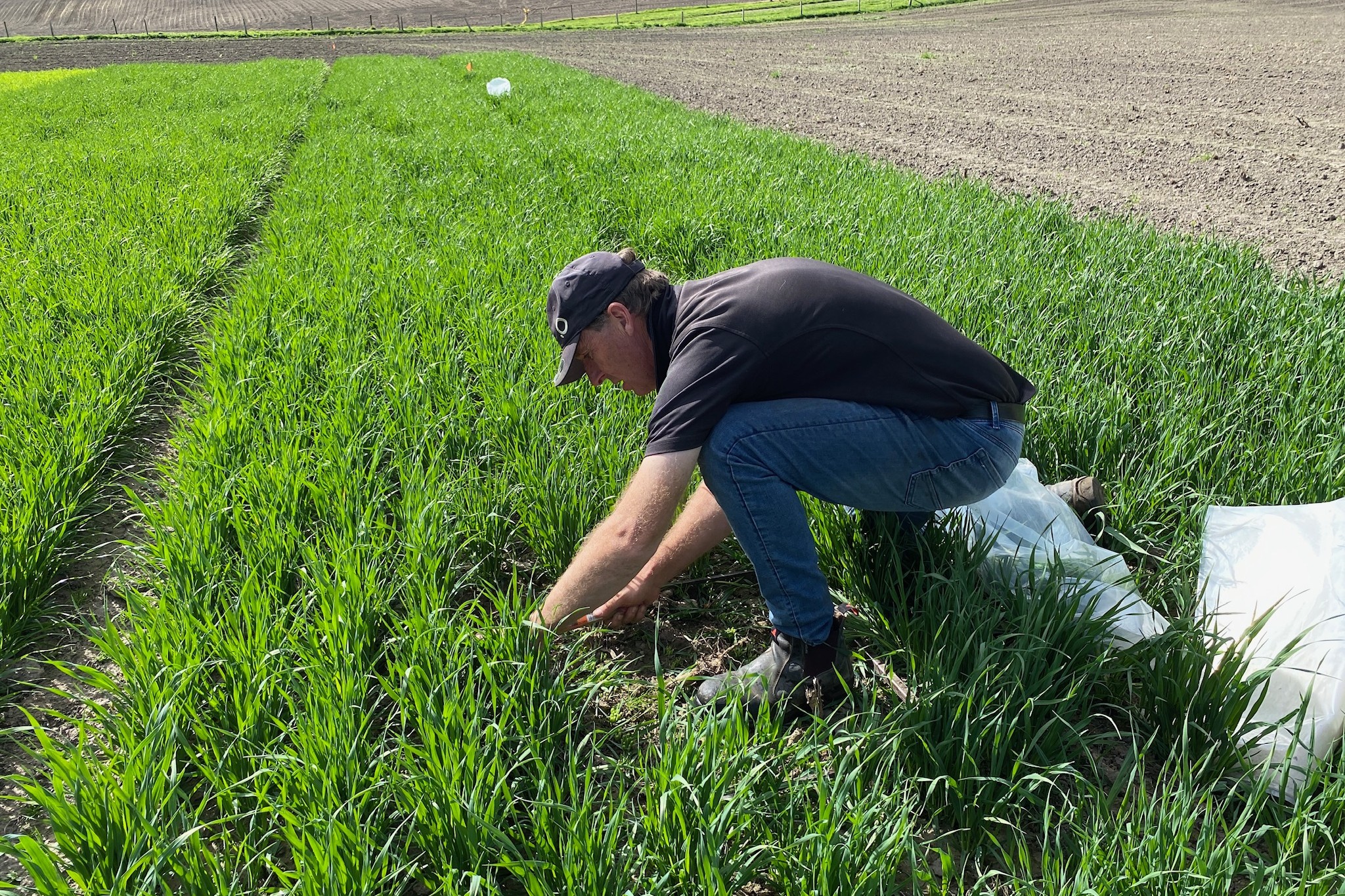
For the past nine years, scientists at Plant & Food Research have been testing the promising solution of the use of catch crops for both its environmental and productive potential. In the context of winter forage crop grazing, a catch crop is to capture excess soil nitrogen after livestock grazing with a promise to both improve environmental outcomes and provide additional feed. The concept has been tested and trials continue to be refined, but the results are proving more compelling than expected.
“We have consistently seen that catch crops, like forage oats, can reduce nitrate leaching losses by up to 60% compared to fallow conditions.” – Brendon Malcolm, Project Leader
Plant & Food Research
“We have consistently seen that catch crops, like forage oats, can reduce nitrate leaching losses by up to 60% compared to fallow conditions,” says Brendon.
Over the last decade, trials in regions such as Canterbury, the West Coast, and Southland have demonstrated that forage oats can effectively reduce nitrate leaching by capturing nitrogen from the soil during their growth. The primary goal of these early trials was to determine how well catch crops could perform in different climates and soil types, especially following winter grazing.
“What’s been most surprising is how well these crops perform even in the toughest environments.”
In trials on commercial farms, the forage oats used in catch cropping have produced yields of between 6–9t DM/ha on average, with some sites reaching up to 12t DM/ha at green-chop silage maturity. The oats have also demonstrated strong metabolisable energy and crude protein levels, making them valuable for livestock feed. This dual benefit – environmental protection and increased feed production – has surprised researchers.
Oats thrive in cold and wet conditions
New Zealand’s climate presents a significant challenge for crop growth, particularly in the winter months when soil temperatures are low and precipitation levels are high. One of the standout findings from these trials has been the ability of forage oats to establish and thrive in cold, wet conditions. But despite these challenging conditions, the trials have consistently shown that oats, even under harsh conditions in areas like Southland, Canterbury, and the West Coast, can establish and grow well. In fact, some of the most unexpected results came from trials in the colder regions of the country. On farms in Canterbury and Southland, where the soil temperatures were low, the oats were still able to grow and capture nitrogen at impressive rates. A multi-season study on intact soil columns in these regions showed that nitrate leaching from winter-grazed land was reduced by up to 60% when forage oats were used, compared to untreated, fallow conditions.
Building on the success of these trials, the research team decided to push the boundaries even further. In 2024, with support from the T.R. Ellett Agricultural Research Trust and co-funding from Environment Canterbury, Plant & Food Research and AgResearch, the team embarked on a new project called Pushing the Boundaries of Catch Crops.
Working along side local catchment groups, the goal was to test catch cropping in some of New Zealand’s most challenging environments – the Canterbury High Country and Inland Otago. These areas are known for their high altitudes, harsh conditions, and unpredictable weather.
The team set up four independent trials on sheep and beef farms at altitudes ranging from 300–700m above sea level. They experimented with different crops, including oats, ryecorn, Italian ryegrass, and barley, as well as various sowing techniques such as tillage and direct drilling. The results were beyond expectations.
“We were expecting challenges,” says Brendon. “But even in these high-altitude regions, the catch crops performed better than we anticipated. In some cases, we were able to achieve yields between 6.8–10.5t DM/ha, with up to 193kg of nitrogen per hectare captured.”
Even at a site near Wānaka, where the weather was exceptionally cold and wet – described by the farmer as a one-in-20-year season – oats still managed to produce yields between 3.1–4.7t DM/ha. Typically, crops in these high-country regions are not sown until late spring, making these results particularly significant.
Germination and Growth
An interesting observation from these trials was the surprisingly high emergence rates at most sites. Despite the cold temperatures, especially at the higher altitudes, the crops established themselves successfully. This was especially surprising given the research team’s initial concerns about germination in such cold environments. As a precaution, they increased the sowing rate of oats in the high-country trials to 160kg per hectare, compared to the more typical rate of 110–120kg per hectare.
“We anticipated that the cold conditions would hamper germination, so we sowed at a higher rate,” says Brendon. “But we were pleasantly surprised by the high emergence rates, which we believe was due to the free-draining nature of the soils, and the relatively dry winter conditions in these areas.”
In addition to the oats, the trials also tested ryecorn. However, the oats consistently outperformed the ryecorn at all sites. The research team attributes this to improvements in oat genetics in recent years.
“The forage oats have really come into their own in recent years,” says Brendon.
Balancing Feed and Soil Health
The key question is how to integrate these successful catch crops into existing farming systems, particularly in regions like the high country where even small quantities of nitrogen leached in sensitive catchments risk environmental damage from winter grazing. Farmers in these areas are facing the challenge of maximising feed production while minimising the environmental impact, and catch crops could provide one of the tools toward an effective solution.
However, there are some challenges to consider. For example, catch crops can deplete moisture reserves in the soil, which can affect the establishment of subsequent crops or pasture. This is a concern that the research team will continue to investigate in future seasons. Additionally, while the trials have shown promising results, it’s essential to remember that conditions can vary significantly from year to year.
 “We’ve seen some great results in this first year of the project, but we need to keep testing and refining these practices,” says Brendon. “The conditions next season could be completely different, so we need to remain cautious and ensure that the practices we’re recommending are sustainable over the long term.”
Ground-Truthing Catch Crops: The Westerfield Demonstration
The team set up a demonstration trial in the Lagmhor-Westerfield catchment near Ashburton with additional funding support through Mid Canterbury Catchment Collective (MCCC).
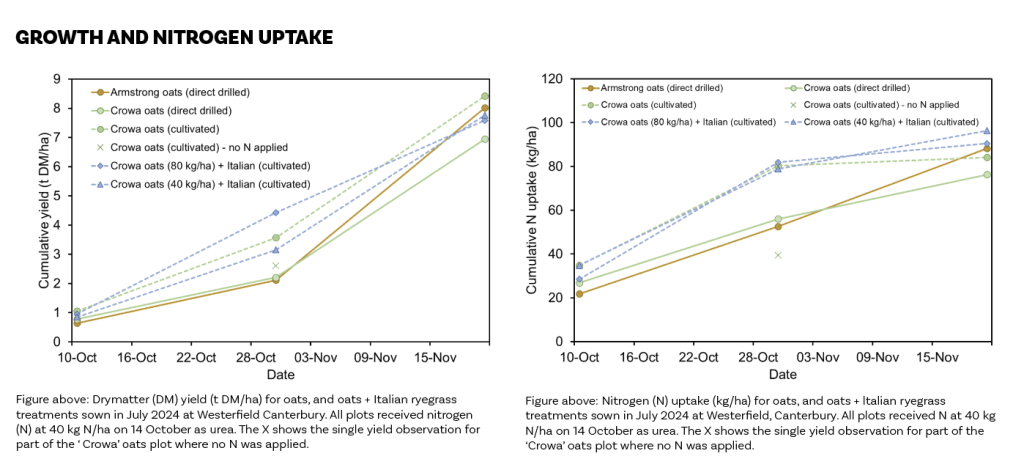
This trial aimed to ground-truth the use of catch crops in a real-world farming setting. The trial involved a series of treatments, including milling oats (‘Armstrong’) and forage oats (‘Crowa’), as well as combinations of oats and Italian ryegrass, which were sown at different rates.
The results from this trial also supported the earlier findings.
The catch crops performed well, yielding between 7–8t DM/ha at green-chop silage maturity in November. Of particular note, the ‘Crowa’ variety of forage oats showed superior growth and nitrogen uptake compared to the ‘Armstrong’ milling oats, during the cooler early growth periods when nitrogen leaching risk is highest. Additionally, the use of minimum tillage proved beneficial, boosting crop performance by approximately 20%.
“This trial really helped us demonstrate the benefits of catch crops to local farmers,” says Brendon. “It’s one thing to see the science in a lab, but it’s another thing entirely to see it work on a real farm, with real conditions.”
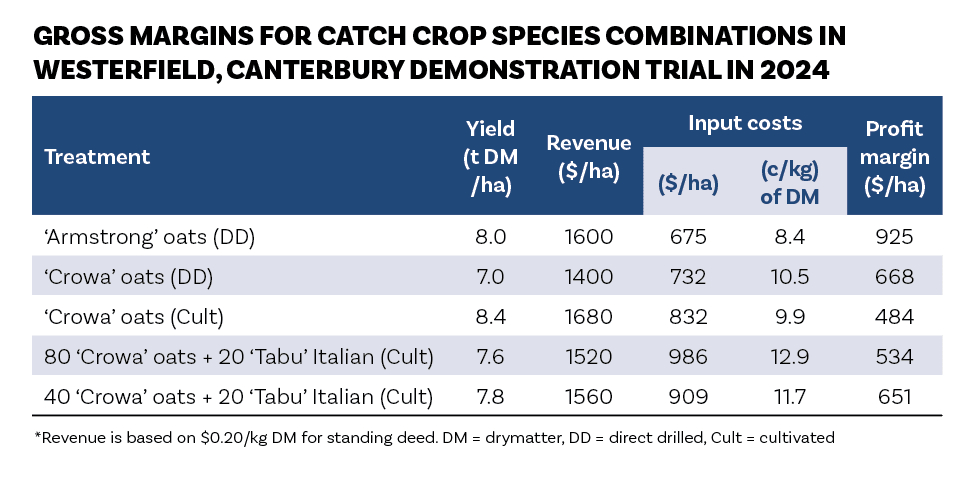
The cost of growing the catch crops ranged from 8.4–12.9c/kg DM. The highest profit margin was shown for the paddock control of ‘Armstrong’ oats, at $925/ha. This was followed by cultivated ‘Crowa’ oats, at $848/ha. Given the slow start of the ‘Armstrong’ oats this result, Brendon says, should be treated with care, as field and/or in-plot variability might have significantly contributed to the noticeable jump in cumulated drymatter at green-chop silage. He states this is somewhat contrary to previous work where true forage oats, bred for high winter activity, typically out-perform
milling varieties.
Key Takeaways
Based on the results of these trials, the research team has outlined several key recommendations for farmers looking to implement catch crops in their systems:
Surface work soil lightly before sowing to address compaction or pugging, especially after winter grazing.
Sow winter-active species such as forage oats, which establish quickly and are effective at capturing nitrogen early in the growth cycle.
Consider including ryegrass in catch crop mixes, as it provides additional feed options and can help mitigate the risks of poor establishment during wet seasons.
“By following these practices, farmers can see both environmental and production benefits,” says Brendon. “It’s all about balancing feed production with sustainable land management.”
As the Pushing the Boundaries of Catch Crops project moves into its second season, the results continue to be encouraging. However, researchers are keen to continue refining the approach and ensuring that the success seen in the trials can be replicated under different conditions. Catch crops, with their potential to both reduce nitrate leaching and provide additional feed, could become an essential tool in New Zealand’s farming toolkit.
“We’re excited by the progress we’ve made, but there’s still work to be done,” says Brendon. “The goal is to create a system that farmers can rely on year after year, regardless of changing conditions.”