Investing Off Farm
The only constant in life is change. When it comes to investing off farm it is important for your asset allocation to balance risk and reward, income and growth, and short-term needs with long-term goals. Is your off-farm investment strategy current? Words Angus Marks, Andrew Austin and Harriet Jones, Wealth Management Advisors, JBWere

Both your personal circumstances and the wider investment environment are always changing. A strong investment plan is not just about setting the right strategy at the start – it also requires regular reviews and communication, and the flexibility to adapt to change.
Success comes from working closely with your financial advisor to ensure your goals remain aligned with your changing circumstances, and your investment strategy keeps up with your needs.
Implementation is the start of your investment journey. What comes next?
Building and implementing your portfolio (as discussed in our previous articles) was the first step in your investment journey; now we need to monitor it.
With an always changing environment, active management and communication with your advisor is essential. Through formal regular reviews, talking during times of market volatility, or discussing personal changes, your advisor can help you understand these changes and adjust your strategy as and when needed.
Long-term or short-term?
As part of this conversation, we need to understand the difference between short-term and long-term changes, factors which might necessitate a small, temporary change and those which require a more fundamental move. Tactical or short-term shifts are generally made in response to a change in the market environment, such as a swing in the value of the New Zealand dollar, or a view the Australian market appears cheap relative to its global peers. Strategic or long-term shifts reflect more fundamental changes. Retirement is a common example, but it might be a change to a long-term view on a given asset class.
“Life will continue to present changes and opportunities, and your investment strategy should grow with you.” – JBWere
A tactical change will usually be quite small, often involving a move of only 1% or so in any asset class. These changes should be approached with flexibility, adjusting the position at short notice if the perceived imbalance that triggered the move is addressed, or the view changes.
By contrast, a strategic or long-term change can almost be viewed as permanent. For example if you are nearing retirement, and want to shift away from growth assets, or if a structural change in a market renders that market less attractive.
Tactical changes can add to portfolio returns, and over the long-term these small gains can lead to better outcomes. More importantly, however, failing to respond to strategic shifts may leave you with an investment strategy that no longer aligns with your goals and leave you with returns that don’t meet expectations. Research consistently shows that getting the strategic asset allocation right is the key factor in achieving long-term expected returns.
The importance of portfolio reviews
The inevitability of change makes regular portfolio reviews essential to maintaining a robust investment strategy. In some cases, more frequent reviews may be necessary if your circumstances change or there are significant market developments. During these reviews, you and your advisor should consider:
- Is your portfolio still aligned with your goals, time horizon, and risk tolerance?
- Have there been any life events or changes that might require adjustments?
- Does the current economic environment warrant a tactical shift or portfolio rebalancing?
- Have your liquidity or income needs changed?
These check-ins ensure that your strategy stays relevant and continues to work in your best interests.
Beyond the numbers
Your relationship with your financial advisor is more than just numbers and reports. It is a trusted partnership built on regular, open conversations, tailored advice, and mutual understanding.
Trust is the cornerstone of a successful advisor-client relationship. Your advisor will work with you to earn and maintain that trust, providing objective advice, consistent support, and personalised strategies.
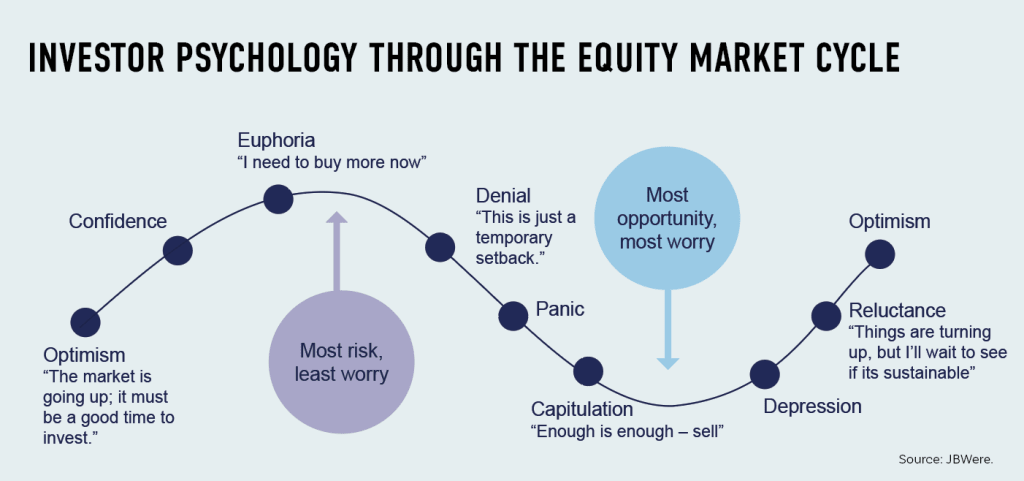
Remaining objective when making decisions can be difficult when so much is at stake. The ‘Investor Psychology Through the Equity Market Cycle’ image illustrates a range of emotions investors may experience on their investment journey. Your advisor can help you understand where we are in the cycle at any point in time, support you to make good decisions, and most importantly, help you avoid making bad decisions.
The initial implementation of your portfolio is not the finish line – it is the starting point. Life will continue to present changes and opportunities, and your investment strategy should grow with you, along with your relationship with your financial advisor.
By staying engaged, regularly reviewing your strategy, and nurturing your advisor-client relationship, you can rest assured that your portfolio is managed to meet both your current financial needs and your long-term aspirations.