Integrating Forestry Into Sheep & Beef Farming
How can sheep and beef farmers see forestry as more than a binary choice between farming and full conversion to pine plantations? New Zealand Institute of Forestry registered Forestry Consultant Peter Handford showcases the business case for sheep and beef operations to integrate forestry to support overall farm management and profitability. Words Peter Handford, Groundtruth.

Integrating trees and forests into sheep and beef farming operations can significantly enhance economic performance, improve resilience and deliver a range of environmental benefits. However, discussions around forestry in New Zealand often become polarised, focusing on the debate over whole-farm conversions to radiata pine plantations. This narrow perspective overlooks the potential of a well-integrated approach that balances forestry with pastoral farming.
Trees and forests contribute multiple services to farming operations, including timber production, biodiversity conservation, stock shelter and shade, carbon sequestration and land stabilisation. A well-planned mix of tree species and forest types across a farm can increase its overall value and long-term economic sustainability.
Understanding the farm landscape and infrastructure
The effective integration of trees into a farm starts with understanding the land’s characteristics, infrastructure and the landowner’s vision for the future.
A critical first step is mapping land types present on the property. Many farms may already have a land-use capability map or a farm plan that identifies different land-use potential, soil types, terrain challenges and management limitations. Land resource inventory and land-use capability classification, developed in New Zealand in the 1970s, remain valuable tools for determining areas best suited for high-value pastoral farming versus those where forestry can provide greater benefits.
There are often areas on farm where pasture production is relatively poor. Shifting these areas from pasture to forest production minimises reduction in pasture production. This also shifts the focus of pasture production to the better land – reducing weed control, fencing and fertiliser costs.
Farm infrastructure (including access roads, water supply, fencing and stock movement lanes) also influences forestry decisions. For example, identifying areas with poor fencing and high investment requirements for stock management may make tree planting a more viable option. Similarly, planning forestry sites near main roads can facilitate log transport, while improving farm accessibility.
Think about location and costs
Practical planning of an integrated forest needs to consider operational costs and efficiencies. Returns on a small forest woodlot can be eliminated by the cost of getting a road to it that can carry logging trucks. Landowners need to think about starting planting fairly close to existing truck access, then extending woodlots further out from there over time as new areas are planted. This way roads can be developed progressively, funded by harvest returns.
How forest areas may be harvested in the future also needs to be considered. Planting areas that form a logical harvest unit with standard machinery will reduce future costs. By contrast, having small areas on the other side of a stream that are steep and difficult to get at may significantly reduce harvest returns – and increase environmental impacts.
Aligning forestry strategies with landowner goals
Each farm is unique, and integrating forestry must align with the landowner’s objectives. Key considerations can include:
- Succession planning: Establishing forestry assets can provide income streams for retiring farmers, while allowing younger generations to focus on stock farming.
- Increasing farm value for sale: A well-integrated forestry plan can raise a farm’s asset value, making it more attractive to potential future buyers.
- Improving land stability and farm ease-of-use: Integrating trees into erosion-prone areas and difficult gullies can enhance overall land usability, while providing economic returns from timber or carbon credits.
Choosing the right forestry approaches
Selecting appropriate tree species and forestry management practices is crucial to achieving the best outcomes for both farm productivity and environmental sustainability.
Radiata pine woodlots
Radiata pine is a well-established commercial forestry species in New Zealand. It is best suited for larger, accessible areas where clear-felling is feasible. However, drawbacks include susceptibility to wind damage and limitations for continuous cover management. Radiata pine is ideal for sites with lower environmental risks.
Special purpose timber species and CCF
Alternative species such as redwoods, cypress and some eucalypts offer high-value timber and can be managed using Continuous Cover Forestry (CCF) systems. These species provide long-term land stability, and can maintain soil protection and support biodiversity. Redwood, for instance, regenerates from the stump post-harvest, maintaining live roots and ensuring continuous land stabilisation.
Native forests for environmental protection
Managing existing native forests, encouraging regeneration and planting new native trees can significantly enhance biodiversity, water quality and soil protection. These forests are particularly suited for steep gullies and areas with sensitive waterways. Although they generate lower carbon income, their long-term ecological and amenity value makes them an important component of farm sustainability.
Silvopastoral systems for direct farm benefits
Integrating trees directly into pastoral systems offers numerous benefits, including:
- Increased pasture production through shelterbelt effects.
- Improved stock welfare with shade and wind protection.
- Enhanced biodiversity.
- Alternative stock fodder sources.
Silvopastoral systems range from shelterbelts and widely spaced trees to carefully managed woodlots, providing both pastoral and forestry benefits.
Balancing forestry with government policies
Government policies, such as the Emissions Trading Scheme (ETS) and forestry grants, influence forestry decisions on farm. However, landowners should prioritise sound land-use planning over short-term policy incentives. While carbon credits provide financial support, basing long-term land-use decisions solely on government schemes carries risk due to potential policy changes. The key is to plan for sound long-term sustainable land management and opportunities for conventional timber return first, then utilise government policies and the ETS to implement this.
Timber production and income diversification
Forestry provides a strategic financial buffer against fluctuating livestock prices. Farmers can plan woodlot harvests to coincide with years of low stock prices or adverse climatic conditions, ensuring business resilience.
Strategic planting can also distribute establishment costs and create staggered harvest opportunities, integrating forestry income as a long-term financial asset. Also, small-scale processing of specialty timber species such as redwood and cypress can provide a contribution to farm income, as well as on-farm materials for fencing, yards and sheds, thus reducing external costs.
Carbon sequestration and revenue opportunities
New Zealand’s ETS allows farmers to generate carbon credits from forests, providing an early income stream before timber harvest. Radiata pine forests, for instance, sequester carbon at approximately 20t/ha annually over the first 15 years, offering significant financial returns at current carbon prices. While native forests sequester less carbon, they contribute to long-term environmental resilience and may become more financially viable as biodiversity credits and other ecosystem service markets develop.
Biodiversity and environmental health
Forests support local biodiversity by providing habitats for native species, stabilising soil and improving water quality. Mixed forestry landscapes (including exotic and native species) enhance ecosystem resilience and can be managed to maintain a network of habitats.
Shelter, shade and animal welfare
Shelterbelts and woodlots contribute to improved livestock productivity by mitigating temperature extremes, reducing heat stress and providing shelter during adverse weather conditions. Strategic tree planting around stockyards, lambing paddocks and shearing sheds can significantly enhance animal welfare and farm efficiency.
Soil and water protection
Forests reduce soil erosion, enhance water infiltration and mitigate peak water flows, protecting downstream ecosystems. Riparian planting along waterways prevents sediment run-off, stabilises streambanks and improves aquatic habitats. Sustainable forest management practices can maintain these benefits, while allowing for periodic timber harvests. Good planning of where different types of forest are established, and how they are harvested, is required.
Long-term business and community impacts
Integrating forestry into sheep and beef farms strengthens economic resilience and supports rural communities by creating long-term locally based forestry employment opportunities. Small-scale well-planned forestry operations can sustain local businesses and maintain balanced land use, avoiding the negative consequences of large-scale land conversions. A reduced-scale integrated approach enables ongoing operation of a small local silviculture crew undertaking planting, pruning and thinning on small- to moderate-sized blocks.
A well-integrated landscape ensures flexibility in adapting to market changes, climate variability and evolving farming opportunities, while maintaining productive land for future generations.
Economic impact on farm systems
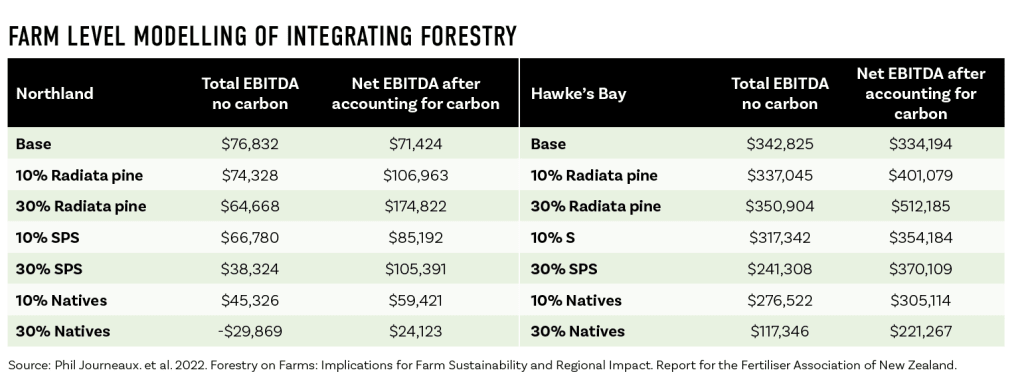
A study for the Fertiliser Association of New Zealand in 2022 (Journeaux et al., 2022) analysed the financial impact of integrating different forestry types into sheep and beef farms using monitor farm data from Northland and Hawke’s Bay (see Table 1). Key findings included:
Establishing 10% of the farm area into radiata pine had a minimal impact on farm earnings before carbon.
Establishing 10% or 30% of the farm area into radiata pine or special purpose species (SPS) improved financial performance when carbon income was included.
Native forestry, due to high establishment costs and lower carbon returns, had a negative financial impact at current carbon prices but it provides long-term ecological and aesthetic value.
This article was first published in the March 2025 NZIPIM The Journal.
Next steps
These are key steps for landowners to get under way:
- Seek advice and take a planned approach: Knowledge is available through the NZ Farm Forestry Association, NZ Institute of Forestry Registered Forestry Consultants, Te Uru Rākau and regional council staff. Developing a property plan is an important early step.
- Identify funding and income opportunities to support cashflow: This includes finding out how mechanisms such as the ETS can support work.
- Develop a practical and achievable work programme: Do things each year as part of the farm work programme. Doing work in a staged way can mean that a good balance in workload for tending and harvesting operations is achieved going forward.
- Establish relationships with proven forest advisors, managers and contractors: This is to provide advice and extra help on the ground when needed.
Integrating forestry into sheep and beef farms offers immense benefits, including increased economic resilience, enhanced environmental sustainability and improved land stability. Success depends on careful planning, land capability assessment and alignment with farm business goals.
Rather than viewing forestry as a binary choice between farming and full conversion to pine plantations, New Zealand’s sheep and beef farmers can embrace integrated approaches that optimise both pastoral production and forestry benefits. Government incentives should be utilised to support well-planned land-use changes rather than dictate them. With a strategic, well-managed approach, integrated forestry can create a more sustainable, productive and profitable future for New Zealand’s rural communities.