Innovation needs a reference
A review of Beef + Lamb New Zealand’s genetics portfolio finds an industry with the capability to tackle its challenges, but says the full value of genomics will only come from investing in the reference population as a whole.Words Sarah Perriam-Lampp.
The New Zealand sheep industry has the technology and the human capability to be confident about its future, but getting the full value out of genomics will require the industry to design and fund its reference population as a whole.
That is the message from University of New England livestock geneticist Dr Robert Banks, who reviewed Beef + Lamb New Zealand’s (B+LNZ) genetics portfolio with Dr Peter Fennessy from AbacusBio. The review drew on about 50 to 60 interviews across all sectors of the industry.
Robert explained to the 2026 Sheep Breeders Forum, held in May in Christchurch, that genetic improvement is the reason the industry still exists. “You wouldn’t be here if you hadn’t had the improvements that have been made through genetics.”
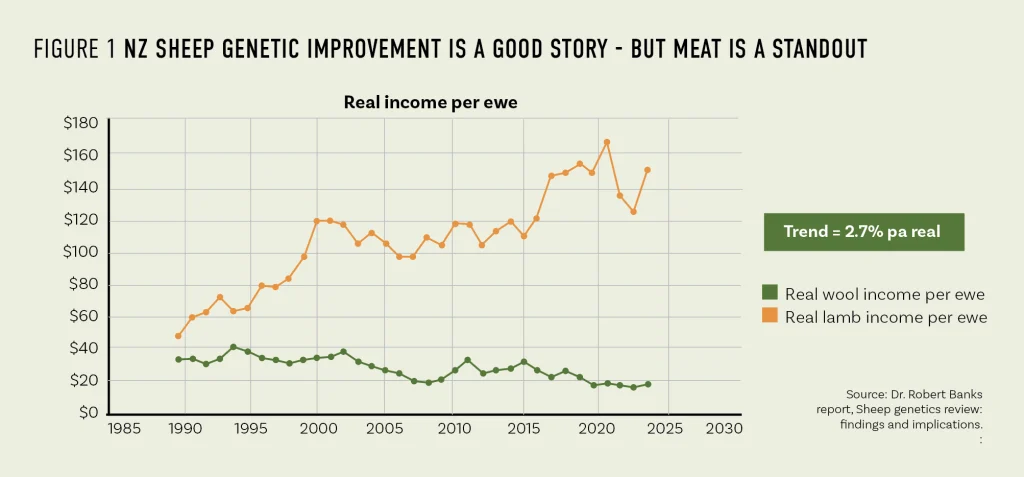
He says that the external environment has changed enormously in the past 20-30 years with the collapse of the wool price about 20-25 years ago and the influx of forestry, neither of which the industry had much control over. Real meat income per ewe has risen about 2.7% a year once inflation is stripped out, through gains in fertility and growth rate, with farmers turning out heavier carcasses and more lambs per ewe.
Total factor productivity improvement has flattened off in the last 10 years or so, says Robert.
While genetic improvement trends have continued at the rate they have run at for more than 20 years, what is produced and delivered has not fully exploited that genetic gain. The further an industry goes with genetic improvement, the more important it becomes to manage those genetics well, which in sheep means managing feed and the animal’s interaction with it.
“Having good genetics means you get more out of management, and having good management means you get more out of genetics. But the two do need to go together in a ratchet.”
Declining ewe numbers carry consequences for research and development funding, he says.
“If they get too small, you start to run out of research & development funds, you start to not be able to meet market commitments and deliver volumes of product.”
The review recommends the industry build a shared vision with measurable targets, a shared investment plan, clear trait development goals, IT infrastructure able to carry a database that will double and double again, and continued investment in communications and human capability. Robert says the industry needs to build and own that vision itself and it might include growing real income and profitability by at least 1% a year, a dramatic reduction in chemical interventions and reduced emissions.
Reducing labour is the big on-farm challenge, along with removing social licence risks. Robert credits Peter Fennessy with framing that productivity improvement keeps the industry in the game, while social licence lets it play the game.
Animal welfare issues, emissions and chemical interventions that raise consumer doubt all need to go, and genetics can contribute to every one of them, he says.
Genomics offers faster genetic progress because the best animals can be identified more accurately and earlier, and progress in traits traditionally seen as too hard, including disease traits farmers cannot readily measure on-farm. Programmes implementing it well are lifting their rate of genetic progress by 40-60%, and in some cases doubling it. That depends entirely on the reference population, the group of animals measured for a trait and genotyped, which is what makes prediction possible in animals with no records of their own.
“If you haven’t measured something in the reference population, you basically can’t predict it in those animals you just read the DNA of.”
Farmers should ask hard questions of anyone selling a genomic test.
“Genomics is really, really great as long as it’s got great data behind it.”
The investment question follows from that: what accuracy the industry has for a trait now, what more accuracy would be worth, and what it will cost to get there.
Robert modelled a scenario for New Zealand with a reference population of a bit more than 100,000 measured animals and 2.5 million animals genotyped. Collecting 83c a genotype would fund a rebate covering a bit under half the cost carried by those doing the phenotyping, giving everyone the same return on investment. Doubling the number genotyped halves that figure.
“We semi-jokingly said we should be genotyping every sheep born in New Zealand. That would be a really great outcome to get to.”
Click here to watch Robert’s presentation at the 2026 Sheep Breeders Forum in Christchurch.