Here comes the sun
Solar farming is a fast-growing part of New Zealand’s energy sector and could be an opportunity for farmers to diversify their income. A Massey University presentation at AgInnovation explored the possibilities for solar farming to co-exist with sheep grazing, providing two sources of income per unit of land area, and crunched the numbers on the returns. Words Rebecca Greaves.

Listen to the Country-Wide Podcast:
Solar farming can add to the bottom line and a Massey University pilot study has found panels have little to no negative effect on pasture production and quality.
Massey, with funding from AGMARDT, undertook a pilot study on a solar farm in Taranaki from mid-2022 to mid-2023 using fixed panels. Presenting at Beef + Lamb New Zealand’s AgInnovation conference, Massey’s Professor Danny Donaghy explained the findings of the pilot study and Professor Peter Tozer outlined bioeconomic modelling undertaken on solar farming. Donaghy explained there was previously no data in New Zealand on the performance of pasture where solar farming is present.The panels had been in place on the farm for about a year prior to the study commencing. Three metrics were recorded in the study – pasture was cut monthly, pasture quality analysis was undertaken every two months, and Facial Eczema (FE) spore counts were taken every month in autumn.
In spring, pasture between the panels rocketed away, with panels providing protection against the wind and the potential positive effect of shading preventing soil from drying out.
Pasture composition directly under the panels was no clover, no plantain and more weeds but overall Donaghy said there was no recorded difference in pasture quality. However, low yields meant there was not enough pasture to get a decent measure in the study. One solution could be to sow more shade tolerant species, like cocksfoot. Legumes do not like shade.
“It’s expensive to put a system in and the most expensive thing is getting into the grid and getting all the consents. You are also at the mercy of the spot price which goes up and down constantly, depending on demand.” – Professor Peter Tozer
One surprising result was that they discovered a trend for much higher FE spore counts away from the panels, with 44,000 spores/gram recorded away from the panels and 10,000 spores/gram under the panels.
In conclusion, Donaghy said there seemed to be a protective effect in between from the panels, which was positive for the pasture, but that benefit disappeared over a 12-month period. However, he said there was no negative effect from solar panels on pasture production or quality, and FE spore counts were reduced, the opposite of what they had expected.
“I’m not selling solar panels but I think there’s an opportunity to make extra income. The negative impact directly under the panels would go away if the panels were higher off the ground, though there is a cost attached to that, and if the panels were spaced a little further apart, the shading would disappear.”
Donaghy said tilt panels, which follow the sun, would also result in much less shading.
CRUNCHING THE NUMBERS
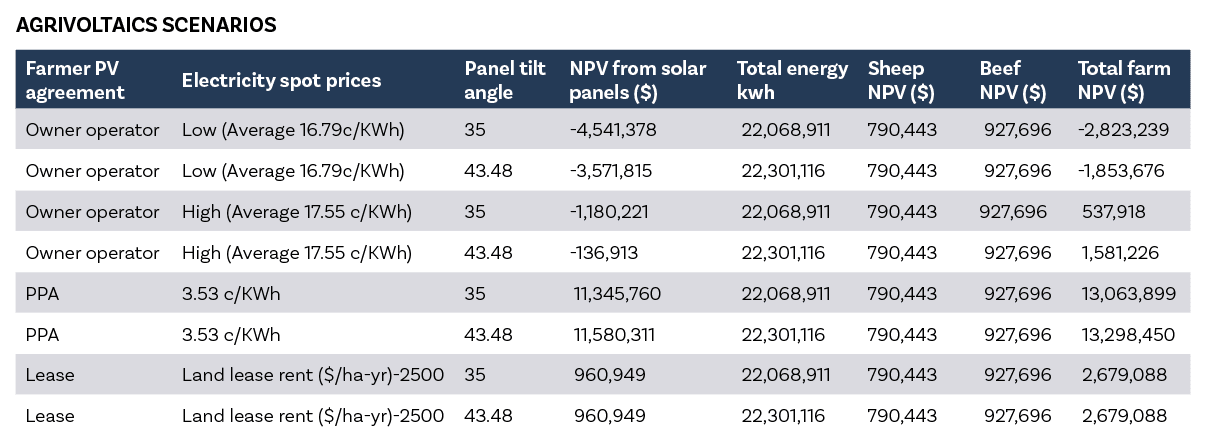
Professor Tozer then took attendees through economic analysis of solar panels when incorporated into a grazing system. The analysis assumed an average 564-hectare sheep and beef farm in the Manawatū-Wanganui region with a sheep to cattle ratio of 60:40, a flock of 2163 mixed age ewes lambing at 133% and a beef herd of 178 breeding cows. The panel area was 35ha of fixed tilt panels (about 50% of that area is covered in panels).
Tozer presented three scenarios: own and operate yourself selling power on the spot market, enter into a Power Purchase Agreement (PPA) with a set price, or lease your farm out to an
entity who take care of everything. Panels need to be on flat land, so the modelling takes into account that 35ha of your best land, equating to roughly 350 ewes or 10 stock units/ha, will be lost from the farming system if solar panels are introduced.
Owner-operator
- This is the easiest and potentially most straight forward option, the farmer purchases the equipment and operates it themselves, selling power on to the grid at the spot price. It’s also the least financially viable way to do it.
- “It’s expensive to put a system in and the most expensive thing is getting into the grid and getting all the consents. You are also at the mercy of the spot price which goes up and down constantly, depending on demand.”
- If farmers choose this option, be prepared to lose a lot of money, Tozer warns. “When you’re generating power, so is everybody else, supply is high so demand is low. It’s a bit of a waste of time.”
- With the lost production from less ewes, even at a high spot price this option only just breaks even. The change in stocking rate means that overall, the farm loses money.
Power Purchase Agreement (PPA)
- The farmer enters into a PPA agreement with an entity, who will purchase the power at an agreed price, which could vary over time.
- Tozer says this looks a lot rosier from a financial point of view. The power price locked in with the PPA is a lot lower, but you are selling all the power generated.
- “There are a lot of people in this industry who are what I would call ‘fly by nighters’, so make sure you have a good agreement.”
Lease
- The third option is to lease your farm out to an entity, who will own and operate the system, and the farmer simply generates lease income. Land is usually locked up for 25-35 years in a lease scenario and at the end of the agreement the farmer can either take over the running, or opt to be left with
a clean site. This is also a viable option, though it adds less to the bottom line than option 2 (a PPA). However, this option means no stress, just sit back and take your $2500/ha/year (price does depend on the farm).
CHALLENGES
Tozer says panel type is a big one here. There are different types – tracking, fixed, transparent, ‘double sided’ panels. The challenge is to get them more efficient.
As outlined by Donaghy, the shading effect is another consideration, what impact do panels have on light and water?
Panel height is important. The higher they are, the more expensive they are. But higher panels will avoid shading impacts and allow sheep to graze under them. Research is continuing on microclimates under panels and the overall effect they have on productivity. Tozer says the price of panels was coming down, but now that panels are becoming more efficient and generating more electricity, that price is climbing back up.
Panels do lose efficiency over time, about 1% each year, and efficiency declining over time was taken into account in the modelling. Some maintenance is required and a maintenance cost was also factored in. “There is some maintenance, but not a lot. Dust is a big thing, if they get dust on them, efficiency drops.”
When questioned about fire risk under panels, Tozer said most of those who are doing solar farming mow underneath panels to reduce the fire hazard.
Panel density comes into play here, high density means weed control and mowing become difficult, and there is also a trade-off between density and pasture production.