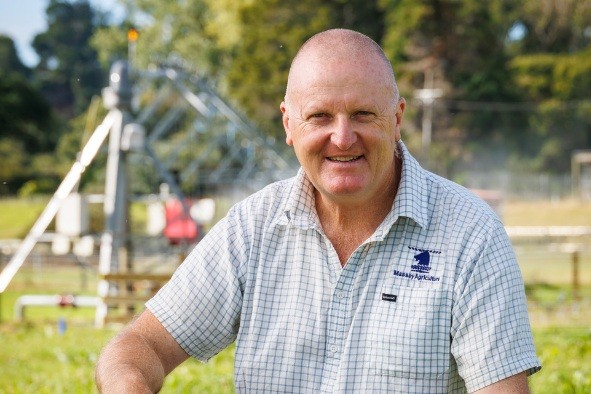

Mike Casey, CEO of Rewiring Aotearoa, says that return is what should be driving farmers’ decisions about energy investment. Solar installed on a single hectare of farmland generates about $100,000 worth of electricity a year at current prices.
“This is moving our economy from foreign energy to New Zealand-made energy, and farmers are gonna be really good at making New Zealand-made energy,” he says.
“We do not have oil wells and refineries on farms, but we certainly do have solar panels on dairy sheds, and that is a really significant outcome for farmers and our people.”
At Fieldays, Casey is focusing on removing regulatory barriers.
“I’m here talking to as many politicians as I can about removing the red tape that exists around farmers installing solar on farms, things that are making solar installations on farms way more expensive.”
He and Federated Farmers are working on four or five policy points aimed at the election, including fair payment for energy pushed back into the grid and the right to choose buyers. The single change that would unlock the most is simple: solar needs to be a permitted activity on farm.
“We do that, and we unlock so much more.”
The case for going early rather than waiting for the next generation of technology is strong.
“Every month that you wait is another energy bill that you have to pay to somebody else.
“Going now is probably advice that’s suitable for 99% of people that are thinking about it.”
Casey says he encountered battery systems at Fieldays selling at $450 a kilowatt hour, half the current market rate.
“Batteries, the way that I describe them at the moment, are kind of like a life jacket.
“You don’t really value them until you’re in the water.”
As events in Southland and Canterbury demonstrated when the wind dropped, farms with batteries on hand are in a fundamentally different position to those without.
Whether farmers are better off self-generating or leasing land to an energy company depends on their situation.
“If you put solar on a hectare of your land on your farm, it’ll make about $100,000 worth of electricity a year at current prices.
“That’s significantly more than what an energy company will rent it from you, but you have to fork out all that capital.”
Whether returns hold at that level depends on whether New Zealand completes its energy transition.
“If everyone converts to electric vehicles, if everyone gets off foreign-sourced energy as much as possible, then there’s gonna be a great return.”
CountryWide CONNECT with Andy Thompson & Sarah Perriam-Lampp is our daily rural show livestreamed from 11am-1pm. Visit country-wide.co.nz on how to watch/listen or download the CountryWide CONNECT mobile app, available on Apple iOS and Android.