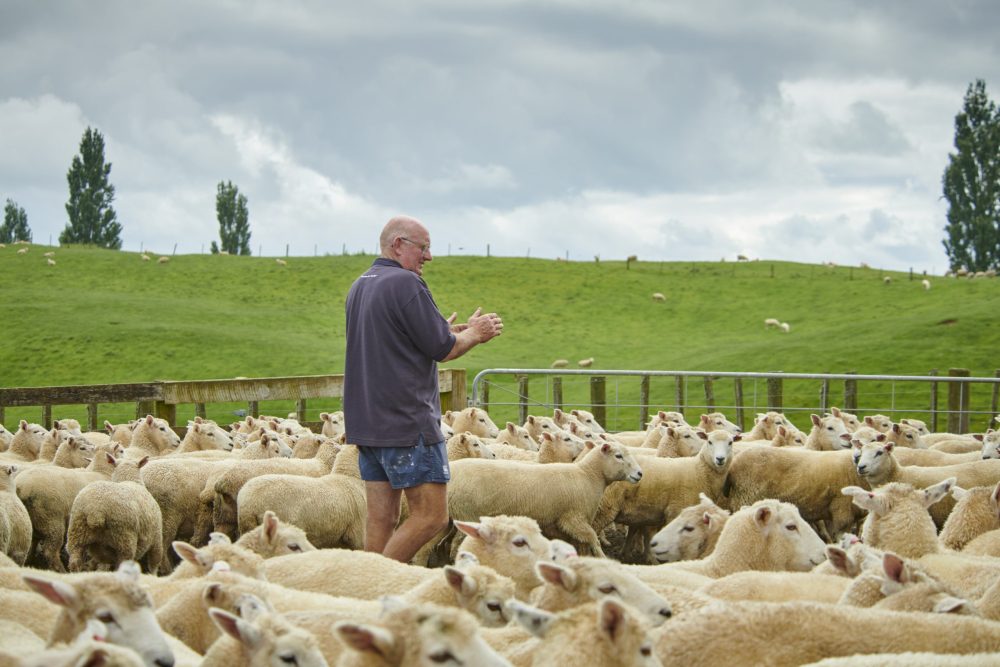
Gaining through collaboration
History shows us that when a group of Kiwi farmers put their heads together, almost anything is possible. Words Mark Ferguson.
The seed for SX Sheep was sown in 2012 when a review of the state of New Zealand’s fine-wool genetics suggested a group of breeders come together to breed a new sheep genotype.
The common goal was to breed a fine-wool sheep resistant to footrot. The animal also needed to have good resistance to internal parasites, reduced incidence of dag, high early growth, high fat and muscle leading to a high condition score, great reproduction and a very saleable fleece.
The New Zealand Merino Company (NZM, now Zentera Wool Company) put out the call. Today, the group represents Melrose near Hawarden, Stonyhurst near Greta Valley, Cleardale at Mt Hutt, Earnscleugh at Clyde and Ida Valley and Matakanui, both near Omakau.
For the first couple of years, the group was supported by NZM and a Primary Growth Partnership with the Ministry for Primary Industries; but for most of the time, they have been self-funded.
The group, set up as a company under chair Dugald Rutherford, focused on achieving genetic gain and supplying genetics to the founding owners rather than selling directly to external parties. Wider industry reach would come through the sale of genetics out of the founding flocks. Originally named Southern Cross, a nod to the composite make-up of the flock, it was later simplified to just SX.
Knowing the end point, finding the start
The group had an end point, but where to start was far less clear. They wanted animals that were resistant to footrot but the work to develop an estimated breeding value (EBV) for footrot hadn’t been completed yet.
They started with commercial ewes that had been exposed to footrot pressure and selected for their ability to withstand the disease challenge in their home flocks. Ewes from four of the founders were used to get things underway. The best fine-wool carcass genetics available were imported and the ewes mated by artificial insemination. The ewe lambs from this first mating formed the nucleus of the group.
Next came the numbers
From the outset, the group were encouraged to base decisions on data, not emotion. Starting with a blank piece of paper – no performance records, no pedigree, just some sheep with a list of tag numbers – there was a bit to do. The group set a ten-year objective and set about building the data set that would allow the calculation of EBVs.
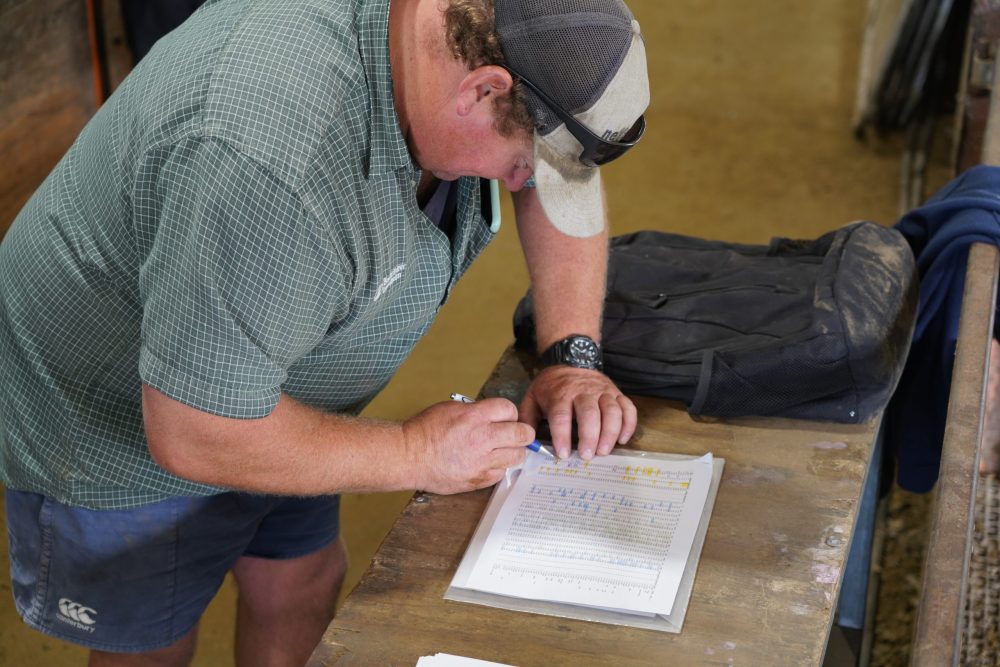
The mission was to ensure that the information used for selection was as accurate as possible. This included scoring every foot of every young ram during a footrot challenge. Worm egg counts were collected under worm challenge, alongside the full raft of production data.
The right place to do it
The nucleus has been based at Stonyhurst since those original ewe lambs came together and it is the perfect place for a programme like this. There is plenty of worm pressure from high stocking rates. Footrot has been in residence on the property for over 100 years. Dag and fly pressure come off the lush green grass of well-renovated pasture and wool quality is challenged by the sea fog and humidity that come with being right on the coast.
All of this could be put to work in the SX programme, allowing the expression of genetic differences for disease resistance and the other traits the group was chasing.
Perhaps the most important factor though, is not the climate at Stonyhurst so much as the passion of the owners for data and change. Setting up the nucleus there aligned with Charlie Douglas-Clifford coming home to the farm a year or two earlier, with a love for numbers and a conviction to breed for profit. For a number of years, Charlie chased down the lambs to gather pedigree and important maternal data. In recent years, that workload has been replaced with DNA technology.
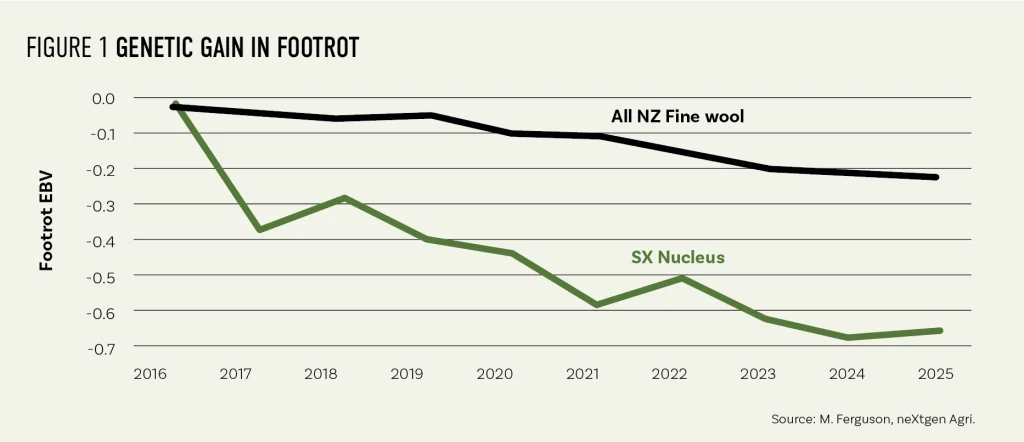
The results have been exceptional and the genetic gain graphs speak for themselves. But the most pleasing thing is seeing how that genetic change is playing out in commercial flocks.
“They bear no resemblance to the Merino sheep – they are free of wrinkle, have clean points and are deeper and wider through the body. The aim has always been to breed them to look more like a Romney than a Merino.” – Mark Ferguson, nextGen Agri
More than the nucleus
In addition to investing in the SX programme, the founding breeders have been applying the same principles within their own ram-breeding flocks, carefully integrating SX genetics as they go.
The sheep Stonyhurst are producing would traditionally have been referred to as a quarterbred in New Zealand, being around 75 percent Merino. But they bear no resemblance to the Merino sheep most people would picture in their heads. They are free of wrinkle, have clean points and are deeper and wider through the body. The aim has always been to breed them to look more like a Romney than a Merino.
Finding the pointy end
When you embark on a programme like this, you need to find the tip of the bell curve. There is a normal distribution for every trait and the job is evaluating enough sheep to find the ones at the pointy end. That can feel like luck and it is tempting to think the group was simply fortunate to identify some extreme sires.
The reality is that it isn’t luck at all. It’s biology and a thorough methodology. It involves establishing a repeatable scoring or measurement system for every trait under consideration and then consistently assessing animals through the generations. To ensure animals can be compared across drops, common sires need to be used across years to genetically link the animals. Getting all of that information processed into EBVs is critical. All sorts of environmental factors impact what we score and measure; turning the data into EBVs takes out this noise and gets us to the genetic differences.
Progress is not always a straight line though. Inevitably, the trait leaders you discover have other things you don’t like about them. The art of breeding is introducing the new trait and keeping the other traits where they are or simultaneously improving them. The SX group have been able to make massive leaps forward in footrot while maintaining their wool traits, improving their carcass traits, improving worm resistance and reducing dags.
In recent years, selection has been guided by a selection index designed specifically for the sheep with weightings that take all of the traits in the desired direction. The group has also made extensive use of computer-based mating software to ensure genetic gain is maximised while keeping close tabs on inbreeding.
Closing the doors is really a beginning
This year, the group has made the call to wrap it up, with the original objectives met and the core breeding nucleus incorporated into the ram-breeding nucleus at Stonyhurst.
The contributing breeders have achieved exactly what they set out to do, introducing the SX genetics into their own flocks and pushing forward with their own programmes. Between them, these flocks now contain the most footrot-resistant fine-wool sheep that have ever been evaluated.
So, while the group breeding scheme is no longer, the SX sheep live on to keep building momentum toward the original aim of increasing fine-wool production out of New Zealand.
The genetic gain graph (Figure 1) shows the improvement made in the SX sheep compared with the industry average.